Safety Bollards & Posts
-
Industrial Safety Barriers, Loading Bay Protection, Safety Barriers, Safety Bollards & Posts
Safestop Bollard 15
ENQUIRE NOW

Safestop Bollard 15
ENQUIRE NOWSVL supplies safety bollards and protective posts for warehouses, manufacturing facilities, loading bays, service yards, car parks and commercial premises across Ireland. The range includes fixed galvanised and stainless steel bollards, flexible and shock-absorbing industrial posts, and heavy-duty options for areas exposed to forklifts, pallet trucks and other workplace vehicles.
The right bollard depends on the vehicle, expected contact, fixing surface, required visibility and the asset being protected. Browse the range below, or ask SVL to assess the location and recommend a suitable product and installation method.
No single bollard is suitable for every location. Use this overview to identify the most relevant option, then open the individual product page for dimensions, installation details and published performance information.
| Product | Typical Application | Product Approach |
|---|---|---|
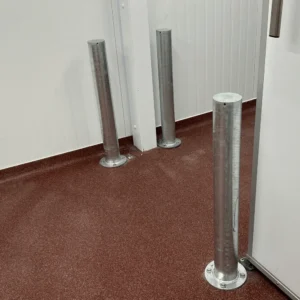
| Galvanised Bollard | Car parks, yards and functional back-of-house areas | Fixed 900mm galvanised steel post with a bolt-down base plate |
| Stainless Steel Bollard | Entrances, building frontages and customer-facing locations | Fixed stainless steel post with a clean satin finish |
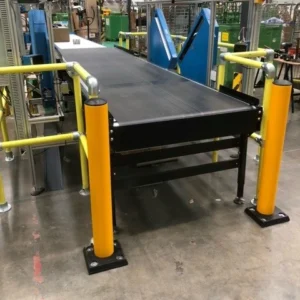
| Flex+ Bollard | Warehouse routes, manufacturing areas and forklift impact points | Shock-absorbing industrial bollard with published impact performance |
| Flexcore Bollard | High-traffic industrial areas where controlled deflection is beneficial | Steel-core and elastomer system designed to absorb and deflect impact |
| Impact Safe Post | Vulnerable equipment, corners and workplace vehicle routes | Heavy-duty steel post with shock-absorbing components and a protective sleeve |
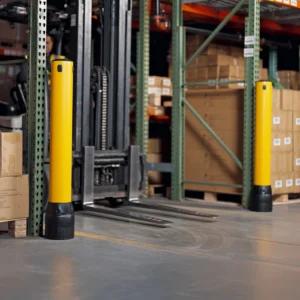
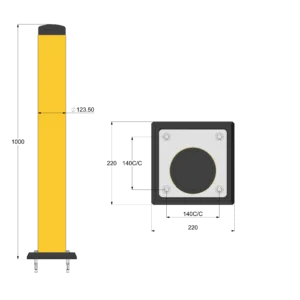
| Safestop Bollard 15 | Industrial areas requiring a higher published impact capacity | Bolt-down shock-absorbing bollard with published resistance up to 15,000 J |
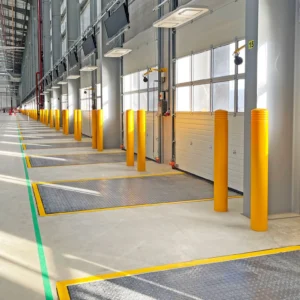
| Service Yard Impact SAFE Bollard | Loading areas, service yards and exposed building approaches | Heavy-duty sleeved bollard available in several heights |
A safety bollard should be selected according to the risk at the installation point, rather than appearance alone.
A car moving slowly in a parking area creates a different risk from a forklift operating beside racking, machinery or a doorway. Consider the vehicle type, operating speed, approach direction and whether contact is unlikely, occasional or expected to happen repeatedly.
A fixed steel bollard can provide a clear physical boundary where significant contact is not expected. In active industrial routes, a flexible or shock-absorbing system may be more suitable because it is designed to manage collision energy and reduce the force transferred to the floor, vehicle or protected asset.
Where defined impact performance is required, choose a product with relevant published test data and confirm that its rating is suitable for the operating conditions.
Many bollards in this range are designed for bolt-down installation on sound concrete. Slab thickness, edge distances, cracks, drainage and underground services can affect the fixing method. Asphalt, block paving or an uncertain substrate may require a dedicated concrete foundation.
High-visibility sleeved or polymer bollards suit busy industrial settings. Galvanised steel provides a functional finish for exposed and back-of-house areas, while stainless steel is often preferred at entrances and public-facing approaches.
Spacing must protect the intended asset without obstructing pedestrians, doors, emergency routes or normal vehicle movement.
For a more detailed comparison, read SVL’s guide to safety bollards in Ireland.
Safety bollards can protect individual impact points or form part of a wider traffic-management and damage-prevention layout. Typical applications include:
Bollards can be coordinated with industrial safety barriers, loading bay protection and car park safety equipment.
For parking-space control and flexible traffic delineation, explore Parking Bollards & Posts.
Established in 2007, SVL provides impact-protection and damage-prevention solutions for commercial and industrial organisations throughout Ireland.
The team can assess vehicle movements, vulnerable assets, available space and fixing conditions before recommending a suitable bollard and layout. SVL can then supply and professionally install the selected system as a standalone project or as part of a wider facility-protection programme.
For a quotation, send the site location, photographs, approximate measurements, vehicle details and a short explanation of what needs to be protected.
Frequently Asked Questions (FAQs)
The correct product depends on the vehicle, expected impact risk, asset being protected, available space, fixing surface and required finish. A site assessment is recommended where vehicle movements are complex or impact performance must be specified.
A rigid bollard creates a fixed physical barrier. A flexible or shock-absorbing bollard is designed to deflect or absorb energy during contact. The better option depends on the impact risk and the level of protection required.
No. Some bollards are intended primarily for boundary definition or straightforward fixed protection, while others have published impact-test data. A product should not be assumed to have a specific rating unless that information is stated and verified.
Most bolt-down bollards require a suitable concrete substrate. An installation on asphalt or paving may need a concrete foundation beneath the surface.
There is no universal spacing. The correct distance depends on the asset, opening width, pedestrian access, vehicle dimensions and likely approach path.
Yes. SVL provides site assessment, product supply and professional installation for commercial and industrial projects nationwide.