
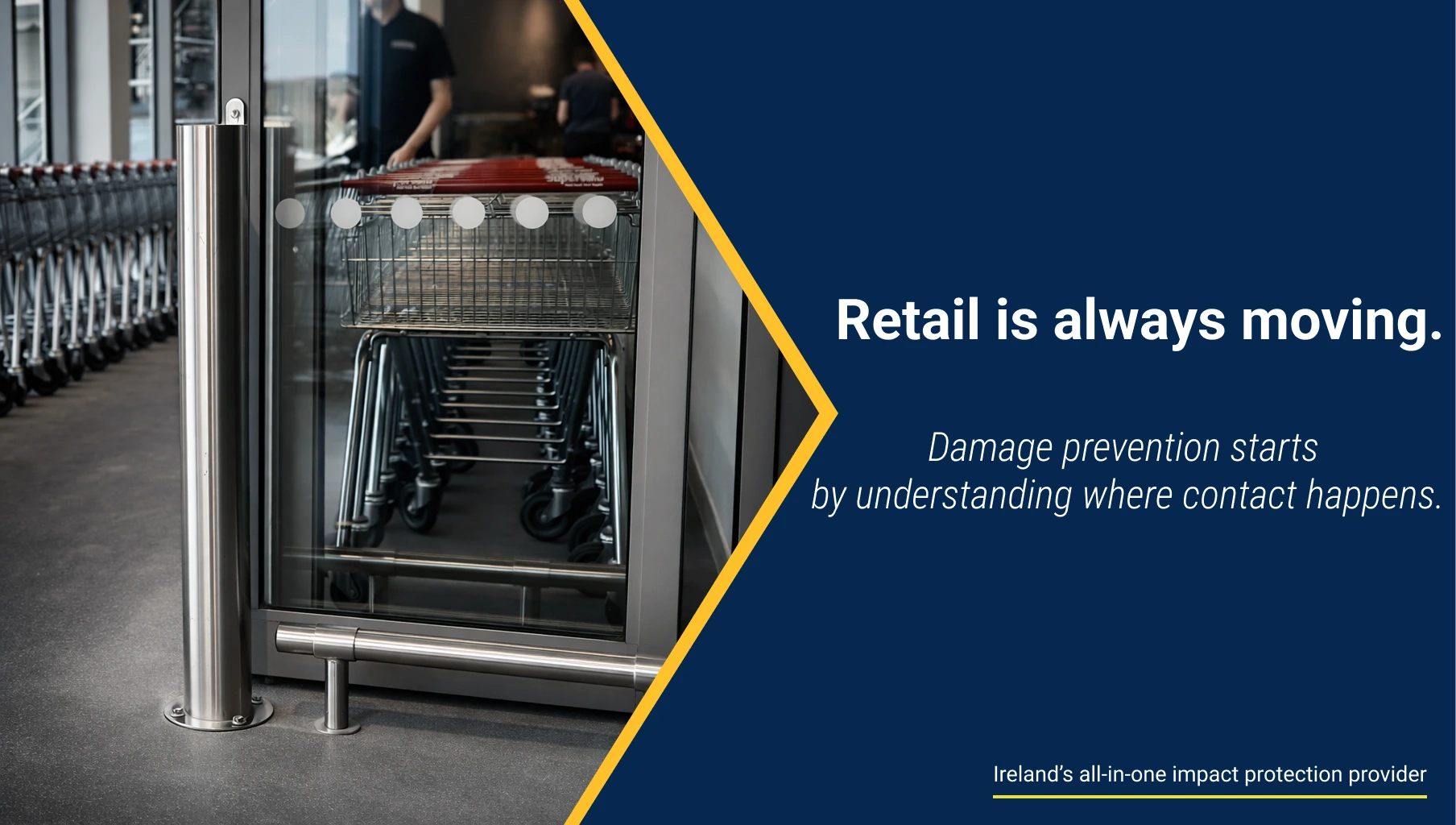
- Introduction: Retail stores are not static spaces.
- Why retail damage prevention matters
- Start outside: the car park is part of the retail workplace
- The shop floor: protection that works quietly
- Back of house: where retail becomes logistics
- Loading bays and service yards need heavier protection
- A practical retail site walk: what to look for
- Choosing the right impact protection product
- How SVL supports retail impact protection in Ireland
- Protect people, protect assets, keep the store working
Introduction: Retail stores are not static spaces.
They are working environments with constant movement.
Customers move through entrances, aisles and checkout areas with baskets, buggies and trolleys. Staff move stock from delivery areas into cold rooms, stockrooms and shop floors. Pallet trucks pass through tight doorways. Cleaning machines operate around fixed fixtures. Cars move through the car park. Delivery vehicles reverse near loading bays and service yards.
The shelves, walls, columns, refrigeration cases, doors, shutters, kerbs and building edges stay in place.
Everything else moves around them.
That is where many retail damage problems begin.
Most store damage is not caused by one major incident. It is more often caused by repeated contact in the same places:
- A trolley clips a refrigeration corner.
- A pallet truck catches a stockroom door frame.
- A vehicle rolls too close to a wall.
- A cage scrapes the same back-of-house corner.
- A loading bay edge takes another knock.
- A car park column gets nudged again.
One mark may look minor. Repeated damage is different. It becomes a maintenance cost, a safety concern, an appearance issue and an operational distraction.
For Irish retailers, this is the practical point:
Impact protection should follow movement.
The right protection is not about adding random barriers around a store. It is about understanding where contact is predictable, then choosing the right physical control for that specific area.
Why retail damage prevention matters
Retail managers are already dealing with sales pressure, staffing, energy costs, customer experience, shrinkage, hygiene, maintenance and presentation standards.
Damage prevention can seem like a small facilities issue until the same problem keeps returning.
A damaged wall corner may be more than a cosmetic repair. It may show that trolley movement is cutting too close to a fixed surface.
A bent post may show that the protection is in the right area, but the specification is not right for the level of impact.
A damaged freezer corner may show that customer trolley movement and asset protection were not considered together.
A marked stockroom wall may show that pallet truck traffic has no clear protection zone.
The Health and Safety Authority notes that hazards in retail workplaces must be identified, assessed and controlled. The legal requirement to manage health and safety applies across the retail sector, from larger distribution environments to smaller retail settings.
In practical terms, retail impact protection helps protect:
- People moving through the store.
- Buildings, walls, corners and doorways.
- Refrigeration units, display fixtures and shop floor assets.
- Vehicles, columns, kerbs and car park infrastructure.
- Loading bay doors, shutters, dock areas and service routes.
- Store appearance and maintenance standards.
- Operational time that would otherwise be spent arranging repeated repairs.
The aim is not to make a retail store feel industrial.
The aim is to keep the store safer, cleaner, easier to maintain and better protected against everyday contact.
Start outside: the car park is part of the retail workplace
For customers, the store often starts in the car park.
For retailers, the car park is more than a parking area. It is a shared movement zone where pedestrians, cars, trolleys, delivery vehicles, lighting columns, kerbs, walls, crossings and building edges all meet.
That makes it a key part of retail damage prevention.
Typical car park risk points include:
- Reversing bays near walls or footpaths.
- Tight turns beside entrances.
- Pedestrian crossings.
- Trolley bay areas.
- Lighting columns and lamp posts.
- Building edges and glazing.
- Kerbs and landscaped areas.
- Service routes that interact with customer parking.
- Delivery access near customer movement.
Low-speed vehicle contact may look small at first, but the cost can build quickly. A vehicle rolling too close to a wall, pillar or verge can damage both the site and the vehicle. A poorly protected lamp post may become a recurring maintenance issue. A car park route with unclear stopping points can put fixed assets under avoidable pressure.
Useful car park protection may include wheel stops, bollards, speed ramps, speed cushions, convex mirrors, lamp post wraps and Armco barrier systems.
The important part is placement.
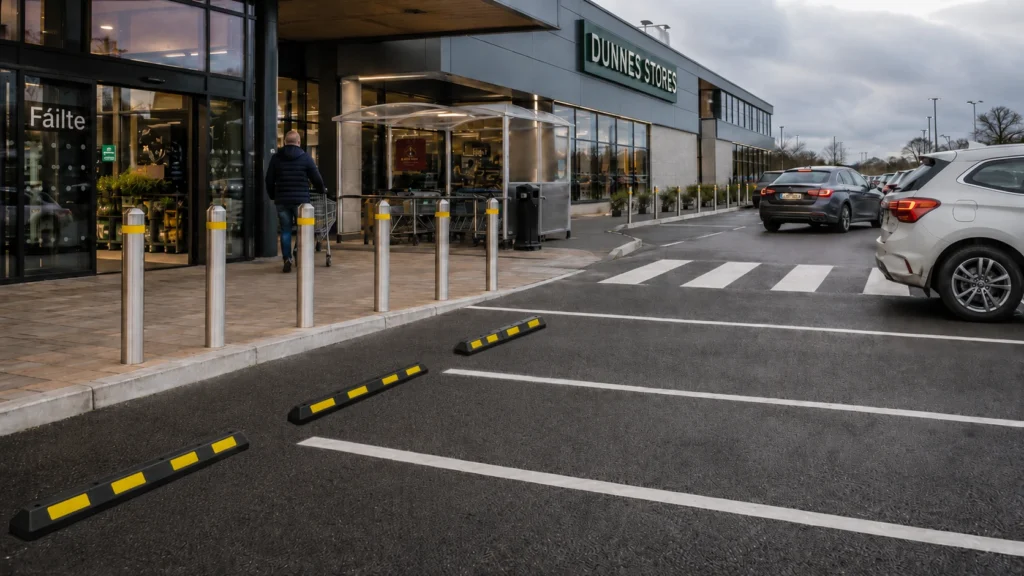
A wheel stop should create a clear stopping point before the vehicle reaches the wall, pillar, kerb or pedestrian zone. A bollard should protect the asset behind it without creating a new obstruction. A convex mirror should improve visibility where the driver or pedestrian has a genuine blind spot. A speed ramp should be installed where slower vehicle movement is operationally useful, not simply where it fits.
The HSA workplace transport guidance covers vehicle and pedestrian movement within workplace boundaries, including cars, vans, large goods vehicles and forklift trucks. It also highlights the need to evaluate the movement of vehicles and pedestrians and put suitable control measures in place.
For retail sites, that makes the car park part of the wider protection strategy.
The shop floor: protection that works quietly
The sales floor needs a different approach from the car park or loading bay.
It is public-facing. It must stay clean, open and easy to navigate. Customers should not feel like they are walking through an industrial site.
At the same time, the shop floor contains expensive and vulnerable assets:
- Refrigeration cases.
- Chillers and freezers.
- Display ends.
- Wall corners.
- Glazing.
- Queue areas.
- Door frames.
- Service counters.
- Shelving ends.
- Cleaning machine routes.
- Entrance and exit points.
These areas are exposed to daily contact from customers, staff, trolleys, baskets, pallet trucks and cleaning equipment.
The best retail protection usually works quietly. It protects the asset without dominating the space.
A stainless steel floor rail can help protect walls, cases and fixtures from dents, dings and scuffs caused by restocking equipment and heavy carts. Fridge corner guards are designed to protect exposed corners on the shop floor and sit close to cabinet cases, which helps reduce unnecessary obstruction.
s is the balance retail sites need:
- Strong enough to take everyday contact.
- Neat enough for a customer-facing environment.
- Easy enough to clean.
- Placed close enough to the asset to avoid wasted floor space.
- Designed around real trolley and staff movement.
A supermarket aisle, pharmacy display, convenience store entrance or forecourt shop needs protection that feels controlled and intentional. The product should support the store, not interrupt it.
Good shop floor protection often protects the things customers do not think about, but staff notice immediately when they are damaged.

Back of house: where retail becomes logistics
Behind the customer-facing store, retail changes pace.
Stockrooms, cold rooms, staff corridors, goods-in areas and service routes are often where the heaviest daily contact happens.
These spaces are usually tighter than the shop floor. Movement is more concentrated. Staff are working quickly. Pallet trucks, cages, delivery trolleys, cleaning machines and stock movements often pass through the same doorways and corners every day.
This is where damage can become normal.
- A scuffed wall beside a stockroom entrance.
- A chipped plasterboard corner.
- A dented door frame.
- A cold room edge with repeated marks.
- A back-of-house wall repaired more than once.
- A corridor where cages always scrape the same surface.
When teams get used to this damage, the site loses useful information.
The marks are not just marks.
They show where movement is making contact.
Wall protection, wall guards, PVC wall cladding, rubber wall guards, corner guards, checker plate, door protection and bumper guards can all help in the right location.
SVL’s wall protection range is suitable for high-traffic environments where walls are exposed to trolleys, pallet trucks, forklifts, door swings and other daily contact.
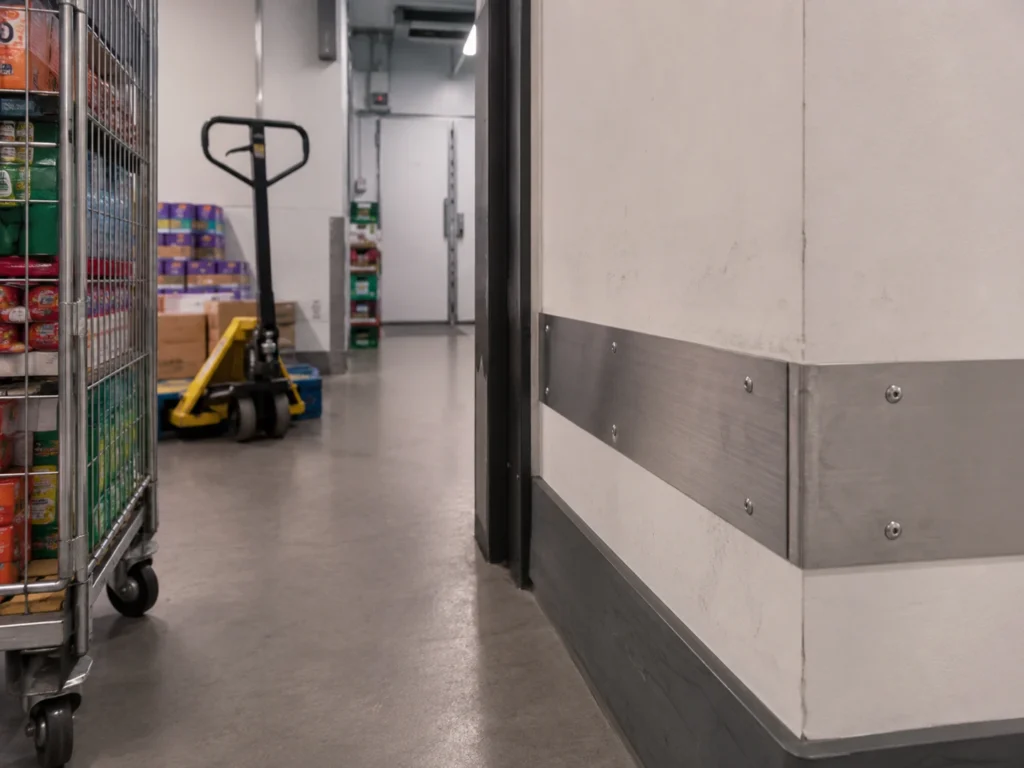
The right solution depends on the area.
A cold room corner may need a different product from a staff corridor.
A stockroom entrance used by pallet trucks may need more robust protection than a customer-facing wall.
A high-contact back-of-house wall may need cladding or a bumper system rather than another repaint.
A racking end needs a different answer from a plasterboard corner.
This is where site knowledge matters.
Retail teams already know where the repeated knocks happen. The next step is to treat that knowledge as practical design information.
Loading bays and service yards need heavier protection
Some of the highest-consequence retail impact risks sit away from customers.
Loading bays, service yards and goods-in areas bring together larger vehicles, reversing movements, staff activity, contractor access, fixed building edges, shutters, dock equipment and time pressure.
These areas often need stronger physical control because the impact energy is higher.
Common risk points include:
- Loading bay doors and shutters.
- Dock edges.
- External walls.
- Service yard boundaries.
- Pedestrian routes beside delivery traffic.
- Waste handling areas.
- HGV stopping points.
- External corners.
- Vehicle turning areas.
A painted line can help show the route.
A sign can warn people.
A procedure can explain what should happen.
But where vehicles, fixed assets and pedestrians operate close together, physical protection often plays an important supporting role.
Loading bay protection may include HGV wheel stops, bollards, impact-safe posts, Armco barriers, rubber fenders, pedestrian barriers and safety barriers.
The purpose is not to replace training or safe systems of work.
The purpose is to make the physical environment support safe operation.
A practical retail site walk: what to look for
A useful protection review does not begin with a catalogue.
It begins with a walk through the site.
Start outside. Look at how cars enter, turn, park and exit. Check where pedestrians cross. Look at kerbs, lamp posts, trolley bays, walls, bollards, verges and building edges.
Then move to the entrance. Watch how customers approach with trolleys. Check glazing, doors, queue routes and any tight turning points.
Walk the shop floor. Look at refrigeration corners, freezer ends, display edges, shelving ends, wall corners, cleaning routes and areas where trolleys repeatedly make contact.
Then go behind the scenes. Follow the route from goods-in to stockroom, from stockroom to shop floor, from cold room to retail area and from service yard to building entrance.
At each point, ask four questions:
- What moves here?
- What can it hit?
- What happens if it does?
- What physical control would reduce the risk without making the store harder to run?
This simple method helps turn everyday observation into a practical damage prevention plan.
It also helps avoid a common mistake: buying individual products before understanding the movement pattern.
A store does not need random protection.
It needs protection that follows the way the site actually works.
Choosing the right impact protection product
The best impact protection product is not always the biggest or most visible option.
It is the one that matches the risk.
For example:
- A refrigeration case on a shop floor may need a floor rail or fridge corner guard.
- A car parking bay beside a wall may need wheel stops.
- A tight vehicle route may need bollards or Armco barrier.
- A blind corner may need a convex mirror.
- A back-of-house wall may need wall cladding, rubber wall guards or bumper protection.
- A loading bay may need HGV wheel stops, bollards or heavy-duty service yard protection.
- A pedestrian route beside vehicle movement may need physical separation with safety barriers or guardrails.
The correct choice depends on several factors:
- The type of movement.
- The weight and speed of the equipment or vehicle.
- The asset being protected.
- The available space.
- The cleaning and maintenance requirements.
- Whether the area is customer-facing or staff-only.
- The level of visibility required.
- The likely frequency of contact.
This is why site assessment matters.
A product that is suitable for a stockroom may not be suitable for a shop floor. A car park bollard may not be the right answer for a service yard. A wall guard that works in a corridor may not be enough for a loading bay.
Good protection is practical, specific and proportionate.
How SVL supports retail impact protection in Ireland
SVL works across the full path of retail movement, from car parks and entrances to shop floors, stockrooms, cold rooms, loading bays, service yards and warehouse areas.
That matters because retail damage does not stay inside one department.
A store manager may deal with a freezer corner issue one week, a car park issue the next month and a loading bay issue later in the year. Treating each issue separately can lead to inconsistent protection and repeated reactive spending.
A whole-site approach is more useful.
SVL can help retail teams review where damage is happening, identify predictable contact points, choose suitable protection products and install practical solutions across different retail environments.
This can include:
- Car park safety equipment.
- Wheel stops.
- Bollards and posts.
- Armco barriers.
- Convex mirrors.
- Retail safety barriers.
- Floor rails.
- Fridge corner guards.
- Wall protection.
- Corner protection.
- PVC wall cladding.
- Loading bay protection.
- HGV wheel stops.
- Pedestrian barriers.
- Service yard protection.
The value is not only in supplying products.
The value is in connecting the right product to the way the site moves.
That is what turns protection from a maintenance reaction into an operational improvement.
Protect people, protect assets, keep the store working
Retail stores are judged every day by customers, staff, auditors, contractors, insurers and managers.
A well-run store is not only well merchandised.
It is controlled, maintained and resilient.
Impact protection supports that standard by reducing avoidable damage, protecting key assets, helping separate movement and making high-contact points easier to manage.
The safest and most durable retail environments are not the ones where nothing ever gets hit.
They are the ones where predictable contact has already been considered.
For Irish retailers, damage prevention should not wait until the next repair.
It should be part of how stores are reviewed, maintained, refurbished and designed.
If your retail site has repeated damage in the car park, shop floor, stockroom, cold room, loading bay or back-of-house area, SVL can help assess the movement and recommend practical impact protection.
Request a Site Assessment
Explore Retail Protection Products
FAQs: Retail impact protection in Ireland
What is retail impact protection?
Retail impact protection is the use of physical products such as bollards, floor rails, corner guards, wall protection, wheel stops, barriers and mirrors to reduce damage caused by everyday movement in retail environments.
Where is impact protection most useful in a retail store?
It is often useful in car parks, entrances, shop floors, refrigeration areas, stockrooms, cold rooms, loading bays, service yards and back-of-house routes where trolleys, pallet trucks, vehicles or cleaning equipment regularly move close to fixed assets.
Why do supermarkets need fridge corner guards or floor rails?
Supermarkets often have exposed refrigeration units, freezer ends and display corners. Fridge corner guards and floor rails help protect these assets from repeated trolley, pallet truck and cleaning machine contact.
What car park safety products help protect retail sites?
Common retail car park safety products include wheel stops, bollards, speed ramps, convex mirrors, lamp post wraps, Armco barriers and pedestrian barriers. The right choice depends on the site layout and movement pattern.
How should a retailer choose the right impact protection?
Start by reviewing how the site moves. Identify what moves, what it can hit, what damage or risk would result, and what physical control would reduce the issue without making the site harder to operate.