
By SVL (Store Vision Ltd) | Published: 2026 | Category: Facility Management | Health & Safety | Car Park Infrastructure

- 1. Executive Summary
- 2. The Hidden Operational Costs: Why Car Park Safety Infrastructure Matters
- 3. Product Ecosystem Deep Dive
- 3.1 Convex Safety Mirrors: Indoor & Outdoor Visibility Solutions
- 3.2 400mm Vista Flex Indoor Convex Mirror
- 3.3 450mm Vista Flex Indoor Convex Mirror
- 3.4 Cable Hose Ramp
- 3.5 Flexi Parking Posts
- 3.6 Flexible Traffic Kerb
- 3.7 Galvanised Bollard
- 3.8 GH18 Wheel Stopper
- 3.9 GH40 Speed Ramp
- 3.10 HGV Wheel Stop
- 3.11 Lamp Post Wrap
- 3.12 Rubber Corner Guard
- 3.13 Speed Cushion
- 4. Regulatory Alignment & Compliance: The Irish Framework
- 5. Installation, Maintenance & Lifecycle Management
- 6. Sector-Specific Use Cases
- 7. Strategic ROI & Comparative Analysis
- 8. Buying Guide & Decision Framework
- 9. Future Trends & Industry Outlook for Ireland
- 10. Conclusion
- 11. References
1. Executive Summary
The Irish commercial and industrial landscape is undergoing a period of sustained infrastructure investment. As domestic logistics networks expand, retail footprints grow, and manufacturing output intensifies, the physical environments in which vehicles, personnel, and pedestrians interact every day are under increasing scrutiny – from both a regulatory perspective and an operational one.
Car parks, service yards, loading bays, warehouses, and distribution centers are no longer passive spaces to be designed and forgotten. They are dynamic, high-risk zones that carry significant liability for occupiers, property managers, H&S officers, and company directors. The Health and Safety Authority (HSA), Ireland’s primary workplace safety enforcement body, explicitly identifies vehicle and pedestrian interaction as one of the nation’s foremost occupational hazard categories. Its Work Related Vehicle Safety framework encompasses everything from forklift operations inside warehouses to delivery vehicles navigating busy car park entrances – and the physical infrastructure that either prevents or enables dangerous interactions.
The problem is not merely abstract. In 2024 alone, 34 lives were lost in Irish workplaces. Transport-related incidents remain persistently over-represented in that figure, year on year. When we zoom into the infrastructure of the typical Irish commercial site – whether a multi-unit retail park in Naas, a pharmaceutical distribution hub in Cork, or a food manufacturing plant in Meath – a recurring pattern emerges: the physical environment has not kept pace with the intensity of modern operations. Yellow line markings fade. Concrete kerbs crack and provide no energy absorption. Rigid steel bollards get knocked and require costly replacement. Lamp posts in car parks become collision hazards.
This is the gap that SVL (Store Vision Ltd), operating from Dublin 12 and serving the entirety of the Republic of Ireland, has been purpose-built to address. SVL’s car park safety equipment range is not a collection of commodity items. It is an engineered ecosystem of materials, products, and systems designed to function as a cohesive safety infrastructure layer – one that meets both the physical demands of heavy traffic and the compliance expectations of Irish regulators.
This article undertakes a rigorous technical and strategic analysis of all thirteen products in SVL’s car park safety equipment range. Rather than cataloguing features in generic terms, it examines the material science behind each product, the specific operational contexts in which they deliver measurable ROI, the regulatory compliance angles most relevant to Irish H&S law, and the cross-sector applications that make these solutions relevant to businesses from hospitality to heavy logistics. It is written for procurement officers who demand specifics, H&S managers who carry legal accountability, and operations directors who want infrastructure that reduces downtime and liability in equal measure.
2. The Hidden Operational Costs: Why Car Park Safety Infrastructure Matters
2.1 The Real Price of an Unmanaged Car Park
Most business owners understand, in principle, that a poorly managed car park represents a risk. What they consistently underestimate is the cumulative and compound nature of that risk when it is left unaddressed over time. The costs of inadequate car park safety infrastructure manifest across at least four distinct dimensions: liability and insurance, physical asset damage, operational inefficiency, and reputational exposure.
Insurance and Liability Costs
Under the Safety, Health and Welfare at Work Act 2005, specifically Section 8, Irish employers bear a primary duty to design and maintain a safe place of work. This duty does not terminate at the warehouse loading dock or the entrance to the car park – it extends to every area under the employer’s control where workers, contractors, or members of the public may be present. When a vehicle collides with an unprotected lamp post, when a truck overshoots a loading bay due to the absence of wheel stops, or when a forklift operator cannot see around a corner because no mirror is installed, the incident does not merely create a safety entry in the accident log. It creates documented evidence of a failure to provide adequate engineering controls – precisely the kind of evidence that insurers and HSA investigators use to establish employer liability.
Irish employers can face both civil liability claims and regulatory fines following such incidents. The HSA’s enforcement powers include Improvement Notices, Prohibition Notices, and criminal prosecution. Courts have demonstrated a willingness to impose significant financial penalties: in one 2025 Dublin Circuit Court case, a single breach of the Safety, Health and Welfare at Work Act resulted in a €650,000 fine against a recycling plant following a fatal incident. While the specifics of each case vary, the underlying principle is consistent – the bar for demonstrating adequate engineering controls is rising every year, and physical infrastructure forms the first line of evidence in any post-incident audit.
Physical Asset Damage
In a car park or service yard environment, unprotected structural elements are continuously subject to minor and moderate impact loads. Lamp posts, wall corners, pillars, and kerb edges absorb vehicle nudges, trolley strikes, and the incidental contact that comes with any high-throughput environment. None of these individual events necessarily causes catastrophic damage, but the cumulative effect – chipped concrete, bent steelwork, damaged cabling behind lamp posts, cracked kerbs – accumulates into maintenance expenditure that far exceeds the cost of proactive protective infrastructure.
Consider a single unprotected car park lamp post. Over three to five years of operation in a busy retail or logistics environment, it may sustain repeated low-speed vehicle contact. The result: structural fatigue in the base, potential electrical cable damage within the post, aesthetic degradation, and eventually a formal repair or replacement program. The cost of that program – excavation, electrical contractor engagement, concrete work, reinstatement – easily reaches several thousand euro per post. A lamp post wrap that costs a fraction of that figure and requires no ground works whatsoever is not a cost; it is a capital preservation measure.
Operational Inefficiency and Downtime
The operational cost of inadequate car park safety equipment extends beyond physical damage. Speed management failures – vehicles traveling too fast through service yards or car parks – create a cycle of near-misses, incident investigations, and productivity interruptions. When a delivery HGV overshoots a loading bay because no wheel stop is present, the vehicle may make contact with the building facade, triggering a formal incident report, an H&S investigation, potentially a Prohibition Notice, and days of lost loading bay access while damage is assessed. Speed ramps and wheel stops are, in effect, operational consistency tools as much as safety ones.
Similarly, a warehouse or logistics operation where blind corners are unaddressed forces staff into a default mode of slowing down and checking before every intersection – an informal and unreliable control measure that relies on individual behavior rather than engineered certainty. A well-positioned convex mirror eliminates this ambiguity, allowing traffic flow to remain efficient while eliminating the collision risk.
Reputational and Compliance Audit Exposure
For businesses operating in regulated sectors – food production, pharmaceuticals, healthcare – a car park or service yard that fails a third-party or HSA audit can create ripple effects well beyond the immediate facility. Retail groups with multiple sites, logistics operators under contract to large FMCG brands, and pharmaceutical distribution centers operating under Pharmaceutical Standards of Ireland oversight all face the reality that inadequate safety infrastructure can trigger not just regulatory action, but contract penalties and reputational damage with key clients.
The financial case for proactive investment in car park safety equipment is, therefore, not simply about avoiding accidents. It is about total cost of ownership of the physical environment – balancing a modest upfront investment in engineered protection against the considerably larger and less predictable costs of incidents, repairs, investigations, and enforcement action.
3. Product Ecosystem Deep Dive
3.1 Convex Safety Mirrors: Indoor & Outdoor Visibility Solutions
Before addressing the Vista Flex indoor models individually, it is worth understanding SVL’s convex mirror range as a system. SVL offers a clearly delineated architecture: outdoor convex mirrors are built around a durable acrylic lens in a high-visibility orange polypropylene frame with a mini visor to reduce glare and rain distortion, available in 300mm, 400mm, and 600mm diameters. These are purpose-engineered for Ireland’s frequently challenging weather conditions – UV-stable, lightweight, and designed for car parks, loading bays, site entrances, driveways, and road junctions.
The indoor range – the Vista Flex series – occupies an entirely different design philosophy. Internal environments do not subject mirrors to UV degradation, rain, or wind load, but they do present challenges of confined space, variable mounting positions, and the need for precise line-of-sight optimization. The Vista Flex models address these with an adjustable metal arm and wall plate system that allows repositioning without redrilling – a feature that matters considerably in fast-evolving warehouse or retail environments where racking layouts and traffic routes can change seasonally.
Material Science: Why Acrylic?
Both the outdoor and indoor mirror lenses are acrylic. This is a deliberate engineering choice, not a cost-reduction measure. Acrylic (polymethyl methacrylate) offers a superior combination of optical clarity, impact resistance, and weather resilience compared to glass. In a warehouse environment, where a mirror at aisle height may be subject to incidental contact from pallet trucks or picking carts, a glass mirror would represent a significant safety hazard in the event of fracture. Acrylic does not shatter into dangerous shards. Its optical properties allow consistent, undistoryed wide-angle reflection – the defining functional requirement of a safety mirror. For outdoor use, acrylic’s UV resistance ensures that the reflective quality does not degrade over time in the way that lower-grade materials can.
The Outdoor Mirror Frame: Orange Polypropylene
The orange polypropylene frame on the outdoor range serves two purposes simultaneously. First, it is a structural housing that protects the acrylic lens from impact and holds the mounting hardware. Second, the high-visibility orange color ensures that the mirror itself functions as a visual warning device – drawing the attention of approaching drivers and pedestrians even before they have the opportunity to use its reflective surface. The integrated mini visor above the lens is a thoughtful engineering detail that manages one of the most common functional complaints about outdoor convex mirrors in Ireland: rain streaking and glare from low winter sun that temporarily obscures the reflected image. By positioning a modest visor above the lens, the product maintains operational effectiveness in conditions that would compromise a lesser design.
3.2 400mm Vista Flex Indoor Convex Mirror
The 400mm Vista Flex Indoor Convex Mirror is SVL’s most compact indoor safety mirror, specifically designed for environments where wall space is at a premium and the blind spot in question is relatively contained. The 400mm diameter provides a practical balance: large enough to deliver a useful field of view at the distances typical of a warehouse aisle or stockroom corridor, compact enough to mount in spaces where a 600mm mirror would dominate the wall or interfere with racking systems.
Technical Anatomy
The mirror features a crystal-clear acrylic lens in the Vista Flex style – the “Vista Flex” designation indicating the indoor-optimized design variant – paired with an adjustable metal arm that allows the installer to direct the mirror face towards the specific blind zone requiring coverage. The wall plate provides a stable, low-profile mounting base that is flush against the wall surface, minimizing the protrusion of the assembly into the operational space. This is relevant in narrow warehouse aisles where protruding fixtures can themselves become collision hazards.
Optimum Applications
The 400mm model is specifically best suited for: warehouse aisle corners with a viewing distance of approximately 3–6 meters; stockroom corners where pedestrian traffic is light but collision risk from trolleys is real; internal corridor intersections in retail back-of-house areas; and packing areas where staff movement routes intersect with trolley or forklift paths. In each of these environments, the compact diameter is an advantage – the mirror does not dominate the visual field or create the sense of obstruction that a larger format mirror might in a tight space.
Why Size Selection Matters
A common specification error in procurement of convex mirrors is the assumption that larger is always better. In reality, mirror diameter must be matched to viewing distance and the width of the zone being monitored. The 400mm model is engineered for closer-range applications; selecting a larger mirror for a space of similar dimensions would produce over-magnification – a distorted image in which objects appear artificially close, potentially creating its own false sense of spatial awareness. SVL’s graduated indoor range (400mm, 450mm, 600mm) allows procurement officers to specify the correct optical tool for each application rather than defaulting to a one-size approach.
3.3 450mm Vista Flex Indoor Convex Mirror
The 450mm Vista Flex is the mid-range indoor option, bridging the compact 400mm model and the larger-format 600mm. Its 450mm diameter makes it the most versatile of the indoor range – practical for tighter installations but offering a wider field of view than the 400mm where the viewing distance is slightly greater or the traffic route being monitored is more complex.
Technical Anatomy
The 450mm model shares the core architecture of the Vista Flex range: acrylic convex lens, adjustable metal arm, and wall plate mounting. The increase in diameter extends the field of view without significantly increasing the physical footprint of the installation. At typical warehouse aisle widths of 2.5–3.5 meters, the 450mm lens provides coverage from approximately 5–10 meters, making it suitable for main aisle junctions, picking area intersections, and back-of-house spaces in retail or hospitality environments.
Differentiating the 450mm from the 400mm
The decision between the 400mm and 450mm models comes down to the geometry of the blind spot and the nature of the traffic involved. In environments where both pedestrians and material-handling equipment (pallet trucks, trolleys) share the same intersection, the slightly wider field of view of the 450mm model provides greater safety margin – it captures a broader swath of the approaching corridor, giving workers more reaction time. For pure pedestrian-only environments or very narrow stockrooms, the 400mm may be adequate and less obtrusive. For mixed traffic environments, the 450mm represents the more complete solution.
Logistics and Picking Areas
One of the most significant under-served applications for indoor convex mirrors in Irish industry is in picking operations within large distribution centres. As e-commerce fulfilment activity has grown substantially in Ireland over the past five years, many former storage warehouses have been converted to dynamic picking environments in which both powered industrial trucks and pedestrian pickers operate simultaneously across an expanded network of aisle intersections. The 450mm Vista Flex is specifically well-suited to this environment – providing the enhanced awareness that prevents the most common category of warehouse transport incident: a pedestrian emerging from an aisle intersection into the path of an approaching pallet truck.
3.4 Cable Hose Ramp
Technical Anatomy
The Cable Hose Ramp is a purpose-built cable and hose management device manufactured from vulcanized rubber – specifically engineered to resist the high pressures generated when vehicles drive over it. The unit measures 900mm long × 500mm deep × 77mm high and weighs 21 kilograms, making it a substantial, stable unit that will not be displaced by the passage of vehicles. It provides three internal channels: two that accommodate cables up to 70mm in diameter, and one that accommodates hoses or cables up to 50mm in diameter. These three channels allow the ramp to manage multiple service lines simultaneously without requiring a separate protective ramp per cable run.
The product’s construction as a series of interlocking sections is a critical feature. Interlocking sections allow the installation to be configured to the precise width of the crossing point required – whether a single-lane pedestrian pathway or a multi-lane vehicle route. It also means that individual sections can be replaced if damaged, without requiring the entire installation to be removed.
The Vulcanized Rubber Specification
Vulcanized rubber is not a generic material choice. Vulcanization is a chemical process that cross-links the rubber polymer chains, producing a material with dramatically enhanced tensile strength, elasticity, and resistance to deformation under load compared to natural or unvulcanized rubber. For a cable ramp that must maintain its channel geometry under repeated vehicle loading – including the dynamic compressive forces of a car or van wheel – vulcanized rubber is the engineering-appropriate choice. The material returns to its original shape and dimension after each loading event, ensuring that cables and hoses within the channels are not progressively crushed over time.
The Hi-Viz Yellow Cover
The top cover of the Cable Hose Ramp is a high-visibility yellow, ensuring that the installation is visible to both drivers and pedestrians in all lighting conditions – day and night. This is not merely an aesthetic decision. It aligns with the HSA’s workplace transport safety guidance principle that physical controls should always incorporate visual warning elements. A cable ramp that blends into a floor surface or a site road is a trip hazard; one that is clearly identified as an obstacle allows users to adjust their speed and footing appropriately. The non-slip surface treatment of the top cover further reduces slip risk for pedestrians crossing the ramp on foot.
Applications in the Irish Context
The Cable Hose Ramp’s primary application profile covers any Irish operational environment where temporary or permanent cable or hose runs cross vehicle or pedestrian routes. This encompasses: outdoor events and festivals (where power and fire suppression cables traverse public walkways); exhibition centers and temporary work sites; industrial facilities where service connections run between buildings across roadways; and any car park or service yard where EV charging infrastructure cables need ground-level protection at vehicle crossing points. The growth of electric vehicle charging in Irish car parks – driven by national decarbonisation targets – is creating new demand specifically for cable protection solutions in commercial car park environments.
3.5 Flexi Parking Posts
Technical Anatomy
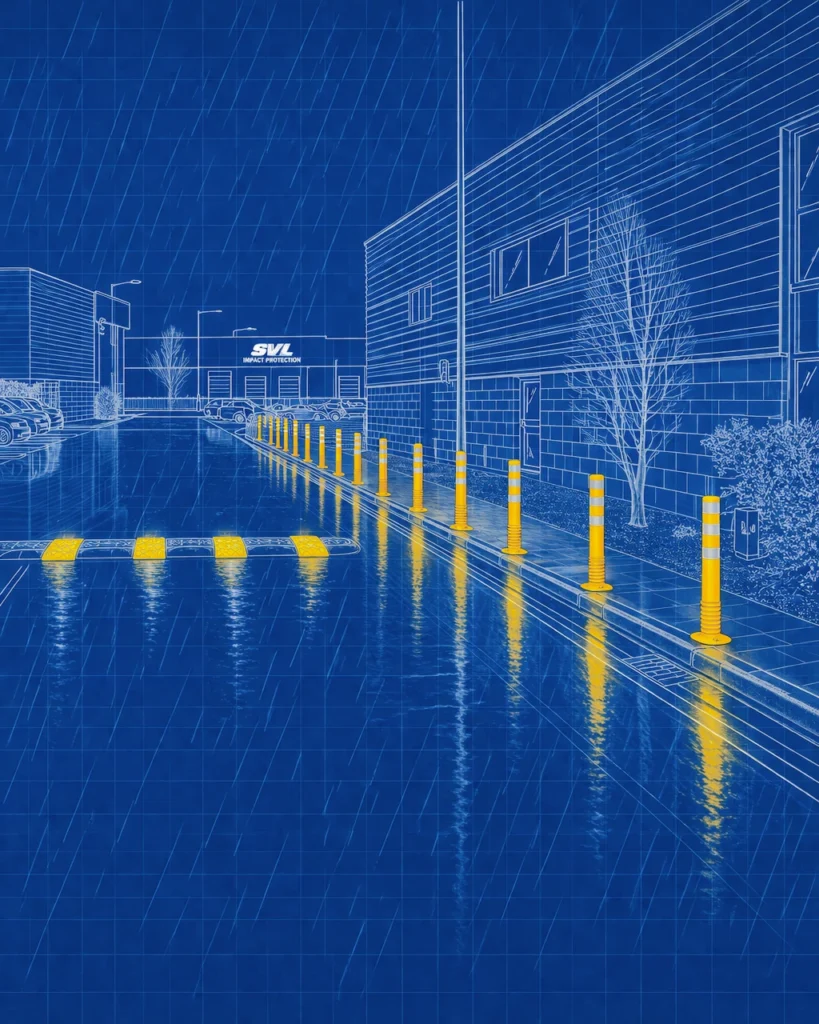
The SVL Flexi Parking Post is an impact-recovery bollard engineered around a fundamentally different philosophy from rigid steel or concrete posts. At 1,000mm in height, it is dimensioned to be clearly visible from a vehicle cab while remaining below the sightline obstruction threshold. The defining technical characteristic is its flexible construction, which allows the post to deflect under vehicle impact – absorbing the energy of the collision – and then return to its upright position without requiring replacement.
The post features a surface bolt-down installation via a base plate, requiring no excavation or in-ground footings. This is a significant operational advantage on existing hardstanding surfaces in car parks and service yards, where ground works would require traffic management, concrete cutting, and extended installation periods.
The Impact Recovery Engineering Rationale
Rigid posts – whether painted steel, cast iron, or concrete – operate on an impact-absorption model that is fundamentally inefficient: the post absorbs the energy of the collision by deforming permanently, and must then be replaced. The cost of replacement accumulates rapidly in any high-traffic environment where minor vehicle contact is common – particularly in delivery yards, multi-storey car parks, and retail car parks where drivers routinely misjudge clearances. The Flexi Parking Post eliminates this replacement cycle. By designed-in flexibility, the post completes the energy absorption-recovery cycle repeatedly, without accumulating damage that requires intervention.
The clean, paint-free finish of the post is also a maintenance consideration that deserves attention. Painted steel posts in outdoor environments require periodic repainting to maintain visibility and prevent corrosion. A maintenance-free finish eliminates this recurring cost and ensures consistent appearance across a site without the visual deterioration that peeling or fading paint creates.
Signage-Ready Design
The post’s design as a signage-ready parking post is a practical feature with significant operational utility. Car parks and service yards consistently require clear visual communication – designation of parking bays, one-way route indicators, height restriction warnings, and restricted zone markings. A post that can carry standard parking sign plates without requiring a separate sign post pole reduces the number of individual fixtures required and simplifies the visual environment of the car park.
3.6 Flexible Traffic Kerb
Technical Anatomy
The Flexible Traffic Kerb is the GH-EKG1 product by Geyer & Hosaja – a precision-engineered vulcanized rubber kerb system dimensioned at 1,000mm wide × 100mm high × 90mm deep. It is manufactured with three pre-drilled holes for bolting directly to the surface, available in Black or Red Brick color finish. The reflective white sections integrated into the kerb body provide supplementary visibility in low-light and night-time conditions.
Why Rubber Kerbing Outperforms Concrete in Managed Traffic Environments
Traditional concrete kerbing in car parks and service yards is dimensionally fixed and permanently installed. When a vehicle mounts a concrete kerb, the result is typically damage to both the vehicle and the kerb – a chipped or cracked kerb block, and a damaged vehicle bumper or underside. The kerb absorbs the impact rigidly, transferring maximum force to both contact surfaces.
The Flexible Traffic Kerb operates on a different material science principle. Vulcanised rubber is inherently elastic within its operating range. When a vehicle tyre contacts the kerb, the rubber deforms slightly to accommodate the contact energy, then returns to its original profile. Damage to the vehicle is reduced. Damage to the kerb is negligible. The installation does not require repair or replacement following typical vehicular contact events.
Traffic Islands and Roundabouts
One of the most technically interesting applications of the Flexible Traffic Kerb is in the formation of traffic islands and roundabouts within car parks and service yards. Conventional concrete kerbing can only form straight or very large-radius curves – the rigidity of the material prevents tighter bends without cutting individual pieces. Rubber kerbing, by contrast, can be laid in curves and circles to define roundabouts, chicanes, or curved channeling routes. This makes the Flexible Traffic Kerb the appropriate solution for designing organic, curvilinear traffic management layouts in Irish car parks – whether in multi-storey facilities, retail parks, or logistics centers.
The product’s suitability for tunnels and underground car parks – specifically noted in the product specification – is significant for Irish urban developments. Dublin in particular has seen continued growth in basement and underground car park construction, where the combination of low light, limited turning radius, and the need for clear lane demarcation makes a retroreflective rubber kerb the operationally superior choice.
3.7 Galvanised Bollard
Technical Anatomy
The SVL Galvanised Bollard is a structural steel bollard manufactured as a CHS (circular hollow section) tube with a welded flat top cap, standing 900mm tall with a 114mm diameter. It is mounted on a circular base plate and bolts down to a solid concrete surface. The defining finishing specification is hot-dip galvanisation – a zinc coating process that bonds metallurgically to the steel substrate to provide corrosion resistance.
The Galvanisation Decision: Material Science Context
Ireland’s maritime climate – characterised by high ambient humidity, regular rainfall, and salt-laden coastal air in many regions – creates a particularly aggressive corrosion environment for ferrous metals. A non-galvanised mild steel bollard in an Irish car park or service yard will begin surface rusting within months of installation, progressing to structural degradation over a few years. This is not merely an aesthetic problem; it is a structural integrity issue. A rusted bollard that has lost cross-sectional area at the base plate connection is no longer providing the vehicle restraint performance it was installed to deliver.
Hot-dip galvanisation creates a zinc-iron intermetallic layer bonded to the steel surface. Zinc is anodic to iron – it preferentially corrodes in the presence of moisture, acting as a sacrificial layer that protects the structural steel beneath. The life expectancy of a properly hot-dip galvanised steel bollard in an outdoor Irish environment substantially exceeds that of painted or powder-coated alternatives, making the galvanised specification the appropriate engineering choice for permanent outdoor installations.
Budget-Conscious Infrastructure Without Compromise
SVL positions the Galvanised Bollard as a high-value option for cost-conscious procurement. The honesty of this positioning reflects a genuine market segmentation: for applications where impact recovery is not the primary requirement – perimeter marking, pedestrian exclusion zones, and permanent zone demarcation – a solid steel bollard offers superior physical restraint capability compared to flexible alternatives. The galvanised finish ensures that this capability is sustained over the operational life of the installation without the maintenance overhead of repainting that painted steel alternatives require.
Applications include car parks, warehouses, delivery yards, stockrooms, and distribution centers – precisely the environments that form the operational focus of the majority of SVL’s Irish customer base.
3.8 GH18 Wheel Stopper
Technical Anatomy
The GH18 Wheel Stopper (product code GH-1800CARSTOP) is a rubber wheel stop designed for standard passenger vehicles and light commercial vans. It measures 1,820mm long × 150mm wide × 105mm high, manufactured from recycled rubber as standard in black, with high-visibility yellow or white lateral strips. Optional painted finishes in green or blue are available to support site-specific color coding. Installation is achieved through four pre-drilled holes using coach screws and dowels suited to concrete surfaces.
Why Recycled Rubber Is the Engineering-Correct Choice
The use of recycled rubber in the GH18 is not merely a sustainability statement – it is a technically superior material specification for this application. Recycled rubber wheel stops offer three advantages over their concrete counterparts that are directly relevant to Irish operational environments.
First, surface conformity: the inherent flexibility of recycled rubber allows the stopper to conform to minor surface irregularities – the undulations and settlement variations that are common in car park surfaces that have undergone multiple seasonal freeze-thaw cycles. A concrete wheel stop that contacts an uneven surface will rock or shift; a rubber one will sit flush and stable, maintaining even contact with the ground and distributing load consistently through all four fixing points.
Second, vehicle compatibility: when a tyre contacts a rubber wheel stop, the energy transfer is progressive and elastic – the tyre compresses slightly, the rubber deforms slightly, and the vehicle stops without the abrupt mechanical impact that a concrete kerb produces. This reduces stress on vehicle suspension components and eliminates the risk of cosmetic damage to low-profile front bumpers. In a managed car park environment, this matters for customer experience as much as infrastructure performance.
Third, corrosion immunity: unlike concrete, which absorbs de-icing salt water and undergoes internal chemical degradation (rebar corrosion, spalling), recycled rubber is entirely resistant to salt, water, and the temperature cycles that characterise Irish winters. This produces dramatically lower maintenance requirements and longer functional life.
Adapts to Uneven Ground
The product specification explicitly notes that the rubber wheel stopper design allows it to adapt to the contour of uneven surfaces – a feature that distinguishes it from rigid alternatives and makes it the appropriate choice for car parks and service yards where perfect surface levelness cannot be guaranteed.
3.9 GH40 Speed Ramp
Technical Anatomy
The GH40 Speed Ramp is a modular rubber speed management device manufactured from vulcanized rubber – specifically from recycled rubber tyres, providing both environmental and structural credentials. Individual sections measure 500mm wide × 400mm deep × 50mm high, installed with four pre-drilled holes per mid-section (three for end sections) using coach screws and dowels into concrete. Each section incorporates a highly reflective “cats eye” retroreflector, maintaining visibility in low-light conditions. The system is available in black and yellow sections, providing strong visual contrast for driver awareness.
Engineering the 15kph Threshold
The GH40’s stated performance characteristic – reducing vehicle speeds to approximately 15kph – reflects a specific engineering relationship between ramp geometry, material stiffness, and vehicle dynamics. A 50mm ramp height at 400mm depth produces a profile that creates noticeable discomfort at speeds above approximately 15–20kph but allows smooth passage at or below that threshold. This is the optimal zone for most Irish commercial car park and service yard environments: fast enough for efficient vehicle movement, slow enough to dramatically reduce the severity of any pedestrian strike should one occur.
Speed Ramp vs. Speed Bump: An Important Distinction
The speed ramp – with its broader, gentler profile – is technically distinct from a speed bump (which is narrower, higher, and designed to limit speeds to below 10kph). The GH40’s profile is specifically calibrated as a speed ramp – broader in base width relative to height – which makes it compatible with both domestic cars and HGV vehicles without causing suspension damage or cargo shifting in commercial vehicles. This dual compatibility is a critical specification detail for Irish service yards and distribution centers where both car park users and delivery vehicles share the same access route.
Recycled Rubber and Sustainability Credentials
The use of recycled rubber tyres in the GH40’s construction provides a material performance advantage as well as an environmental one. End-of-life rubber tyres are vulcanized, carbon-reinforced, and engineered to withstand dynamic loading – properties that translate directly into the performance requirements of a speed ramp. The recycled material is already proven in its mechanical properties by its previous service life, and the manufacturing process adds structural value without the energy intensity of producing virgin rubber or concrete alternatives.
3.10 HGV Wheel Stop
Technical Anatomy
The HGV Wheel Stop is a specialist loading bay safety device manufactured from 100% recycled rubber with a moulded-in 50mm yellow glass bead high-visibility strip along the top surface. It measures 1,000mm long × 300mm wide × 150mm high – substantially more robust in cross-section than the GH18 passenger vehicle stopper – and is installed through five pre-drilled holes into a solid concrete surface. The product is explicitly not suited for domestic vehicles; it is engineered specifically for larger vans and heavy goods vehicles.
The Engineering Case for HGV-Specific Wheel Stops
A loaded HGV at a loading bay may weigh between 20 and 40 tonnes. The wheel loads involved are categorically different from those of a passenger vehicle, and a wheel stop dimensioned for a car will not provide the restraint required for commercial vehicle applications. The HGV Wheel Stop’s 150mm height and 300mm base width reflect the geometry required to resist these larger loads and bring a heavy vehicle’s wheel to rest in the correct position relative to the loading dock.
The product’s design incorporates an important operational detail: a short side for the vehicle wheel to rest against (providing the physical stop signal to the driver), and a longer lower face angled away from the short side. This asymmetric geometry serves a specific purpose – if the vehicle is driven over the stopper (typically due to driver inattention or reversing at excessive speed), the longer lower face creates a ramp surface that guides the wheel back to the correct stop position on the forward pass. This self-correcting geometry reduces the risk of the vehicle overshooting the dock entirely, which can result in the trailer disengaging from the dock leveler and creating a fall hazard.
Glass Bead Hi-Viz Strip
The 50mm yellow glass bead strip moulded into the top of the HGV Wheel Stop is a retroreflective safety feature. Glass bead retroreflection – the technology used in road markings – returns light towards its source across a wide range of angles, providing strong visibility both to the driver in the cab and to pedestrians in the loading area in low-light conditions. Moulding this strip into the rubber body, rather than applying it as an adhesive strip, ensures that the retroreflective element does not delaminate or peel over time under the mechanical and weather loads typical of an outdoor loading bay.
Zero Maintenance Advantage
The 100% recycled rubber construction of the HGV Wheel Stop eliminates two of the most significant recurring costs of steel or concrete alternatives: corrosion and repainting. In a loading bay environment where the wheel stop is subject to daily contact with vehicle tyres, hydraulic oil, road grime, and de-icing chemicals, the maintenance freedom of a rubber product translates into a meaningful operational cost saving over the product’s lifecycle.
3.11 Lamp Post Wrap
Technical Anatomy
The Lamp Post Wrap is a two-piece clamshell-design protective sleeve manufactured from tough polyethylene with a high-density foam impact-absorbing core. It stands 1,250mm high with a 285mm outer diameter and is designed to fit lamp posts with pole diameters ranging from 50mm to 210mm – achieved by removing foam core sections to accommodate the specific pole diameter of the installation site. The outer surface incorporates diamond-grade retroreflective bands, ensuring visibility in all weather conditions, day and night.
The Material Science: Polyethylene and Foam Core
The combination of a polyethylene shell and a high-density foam impact-absorbing core is an engineered layered system. The polyethylene outer shell is impact-resistant and weatherproof – it maintains its structural integrity in the rain, temperature extremes, and UV exposure characteristic of Irish outdoor environments. When a vehicle makes contact with the wrap, the outer shell transmits the impact energy to the foam core, which compresses to absorb and dissipate that energy. The result is a substantial reduction in the peak force transmitted to the lamp post structure – and, critically, a corresponding reduction in damage to the vehicle’s bumper.
Diamond-grade retroreflection – the highest standard of retroreflective material, as used on motorway signs – ensures that the lamp post is visible to drivers from a significant distance, even at night or in poor weather. This transforms what is essentially a passive infrastructure element (a lamp post) into an active visual warning device that continually communicates its presence to approaching vehicles.
The Economics of No Excavation
The traditional approach to lamp post protection in Irish car parks has historically been to install a concrete or steel kerb surround at the base of the pole – requiring excavation, concrete pour, and a waiting period for the concrete to cure. The Lamp Post Wrap eliminates this entirely. The two-piece clamshell design clips around the existing pole and is held in position by the foam core friction fit with the pole surface. There is no bolting down, no ground works, and no requirement for a specialist contractor. An individual wrap can be installed in minutes by two operatives.
This has particular relevance in operational environments where ground works are costly and disruptive – multi-storey car parks with waterproof membranes that cannot be penetrated, retail park car parks where traffic management during works creates significant business impact, and underground car parks where concrete reinforcement is structural.
3.12 Rubber Corner Guard
Technical Anatomy
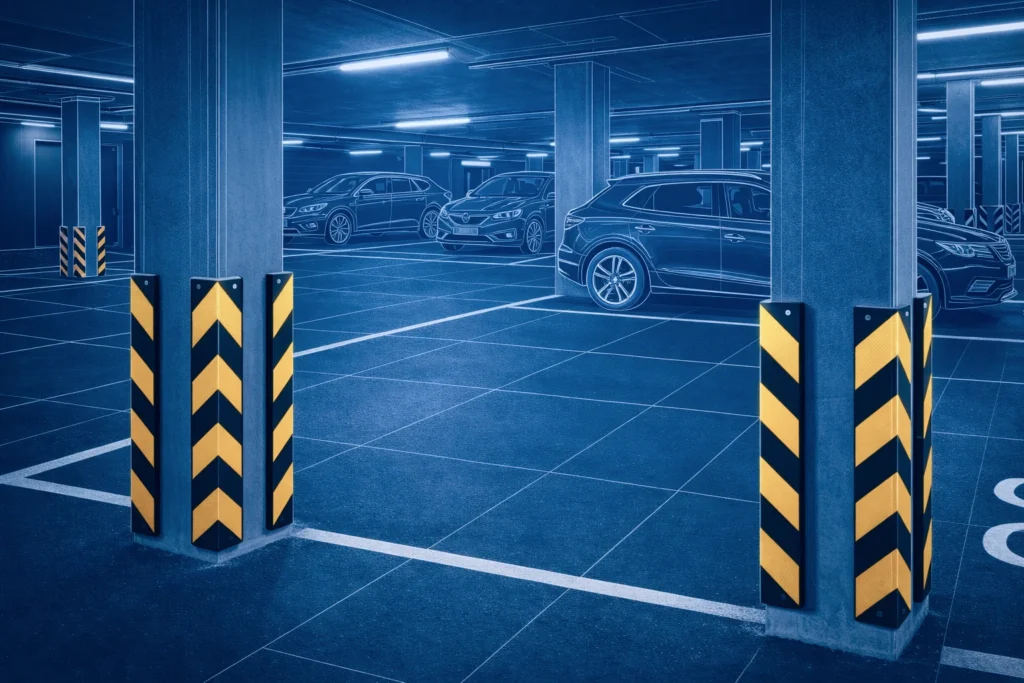
The Rubber Corner Guard is a heavy-duty wall corner protection product manufactured from recycled rubber with a high-visibility black and yellow color scheme. It stands 800mm high with 90mm of coverage on each face of the corner, providing a 90° × 90° internal profile that wraps the full corner geometry. The 10mm thickness is engineered to absorb and deflect impact energy without excessively protruding into tight spaces such as car park ramps, loading bay columns, or warehouse corridor corners. The product carries pre-drilled fixing holes for direct installation to concrete, blockwork, or steel surfaces and complies with EU Directive EC 92/58 for safety signage color schemes.
Impact Absorption and Structural Protection
The primary engineering function of the Rubber Corner Guard is twofold: to protect the building structure from damage caused by vehicle, forklift, or trolley impact, and to protect the vehicle or equipment from damage. Unprotected structural corners – particularly in car parks where concrete pillars carry a combination of vertical load and horizontal slab support – are vulnerable to impact damage that can, over time, compromise the structural integrity of the reinforced concrete. A rubber corner guard absorbs and distributes the impact energy across a larger surface area, reducing the peak stress on the concrete and preventing the progressive spalling that unguarded corner impacts produce.
EU Directive EC 92/58 Compliance
The black and yellow color combination of the Rubber Corner Guard is not arbitrary – it is the EU-standardised hazard marking scheme, recognised under EU Directive EC 92/58, which governs the minimum requirements for safety and health signs in the workplace. This compliance means that when an organisation installs SVL Rubber Corner Guards, the hazard marking function of the product is legally defensible – it communicates a recognised hazard warning in a format that regulators, insurers, and auditors will accept as a genuine engineering control.
Car Park Pillar and Ramp Application
The Rubber Corner Guard is particularly well-suited to the angled corners of car park ramp structures, where vehicles making the transition from level floor to ramp approach structural edges at an angle that creates high collision probability. In Irish multi-storey car parks and basement car parks – environments that combine tight turning radii, reduced visibility, and varied driver competence – unprotected corners on ramp abutments are a consistent source of both vehicle damage and structural deterioration.
3.13 Speed Cushion
Technical Anatomy
The SVL Speed Cushion is the GH-PQ.B Quartet product by Geyer & Hosaja. It consists of four segments arranged in two pairs (2 left and 2 right) to form a quartet installation. The outer surface is UV-stabilised vulcanised rubber; the interior uses recycled rubber, providing a durable, weatherproof, and anti-slip surface. The anti-slip surface meets the European SRT 48 standard – a friction measurement standard for pedestrian slip resistance. Two versions are available: the Q2 Small Quartet at 2,000mm long × 1,800mm wide × 65mm high (200kg), and the Q3 Large Quartet at 3,000mm long × 1,800mm wide × 65mm high (280kg). Colors available are red with white markings, and black with yellow markings. Sections connect with H-connectors and rubber bungs to conceal fixings.
The Technical Superiority of the Quartet Design
The critical engineering innovation in the speed cushion design – versus a conventional full-width speed bump – is the quartet segment arrangement. Because the four segments leave gaps between them at either side, wide vehicles (buses, HGVs) with wide axle widths can pass over with their wheels in the gaps, experiencing minimal vertical movement and therefore minimal discomfort to passengers or cargo. Narrow vehicles (cars, vans) with a narrower wheel track will encounter one or more segments with each wheel, producing the speed-reduction effect.
This selective speed management is not a compromise – it is a precision engineering feature that makes speed cushions the appropriate solution for any road shared by both public transport and private vehicles. On the approach routes to many large Irish retail parks, distribution centers, and campus environments, buses, delivery vehicles, and private cars share the same entrance lane. A full-width speed bump would subject buses and heavy vehicles to the same abrupt vertical load as a private car – causing passenger discomfort, cargo damage, and potential vehicle suspension stress. The speed cushion quartet eliminates this conflict.
UV-Stabilised Vulcanized Rubber
The UV-stabilised outer layer is a material specification detail that deserves emphasis in an Irish context. Standard rubber products exposed to outdoor UV radiation will undergo photodegradation – the long polymer chains in the rubber are broken by UV energy, causing surface cracking (crazing) and progressive material loss. UV-stabilised formulations incorporate additives that absorb or reflect UV radiation, preventing this degradation. In Ireland, where the UV index is moderate but solar exposure occurs year-round, this stabilisation significantly extends the service life of outdoor rubber products.
The GH Speed Cushion’s specification as both waterproof and stable – and as a “great choice for temporary trials” – reflects the product’s flexibility as both a permanent installation and a reversible trial measure. Facilities managers assessing traffic management layouts can deploy speed cushions temporarily to test the effect on vehicle behavior before committing to permanent installation.
4. Regulatory Alignment & Compliance: The Irish Framework
4.1 The Safety, Health and Welfare at Work Act 2005
The foundational Irish legislation governing workplace safety is the Safety, Health and Welfare at Work Act 2005. Section 8 of this Act places a comprehensive duty on employers to, so far as is reasonably practicable, manage and conduct all work activities in such a way as to ensure the safety, health and welfare of employees and those not in employment who may be affected by those activities. This duty is expansive – it covers the physical design of the workplace, the selection and maintenance of equipment, and the organization of traffic management.
Section 19 of the same Act mandates the identification of hazards and the carrying out of risk assessments. For a car park or service yard operated by an Irish business, the failure to install adequate vehicle speed management, wheel restraints, or visibility enhancements where these are identifiable controls for known hazards is a direct failure of Section 19 compliance.
4.2 HSA Workplace Transport Safety Framework
The HSA’s Workplace Transport Safety guidance, which sits within its broader Work Related Vehicle Safety framework, identifies the following as primary engineering control requirements for managed vehicle environments:
Vehicle Speed Management: The use of physical speed reduction measures – speed ramps and speed cushions – to ensure vehicle speeds are appropriate for the operating environment. The GH40 Speed Ramp and the GH Speed Cushion Quartet directly address this requirement.
Vehicle Restraint and Positioning: Wheel stops and wheel stoppers to prevent vehicles overshooting their intended stopping position. The GH18 Wheel Stopper and the HGV Wheel Stop address this at the respective vehicle class level.
Visibility Enhancement: The provision of mirrors or other visibility aids to eliminate blind spots and improve awareness at intersections and corners. SVL’s full convex mirror range – both the outdoor acrylic/orange-frame models and the indoor Vista Flex series – address this directly.
Traffic Segregation and Route Demarcation: The use of physical kerbing, bollards, and flexible posts to define and maintain separate vehicle and pedestrian routes. The Flexible Traffic Kerb, Flexi Parking Posts, and Galvanised Bollard address this requirement.
Protection of Fixed Infrastructure: The use of corner guards, lamp post wraps, and similar protective products to prevent structural damage that could create secondary hazards. The Rubber Corner Guard and Lamp Post Wrap address this.
4.3 Cable Management and Electrical Safety
The Cable Hose Ramp addresses a specific compliance angle that intersects both the Safety, Health and Welfare at Work Act and the Electricity at Work Regulations – the requirement to protect electrical cables and services from mechanical damage. In event, festival, and construction environments, unprotected cables trailing across vehicle routes represent both a safety hazard (trip hazard, vehicle snag) and an electrical safety risk. The interlocking vulcanized rubber construction of the Cable Hose Ramp provides a compliant, inspectable protection measure for these installations.
4.4 EU Directive EC 92/58 and Safety Signage
The Rubber Corner Guard’s compliance with EU Directive EC 92/58 – which establishes minimum requirements for workplace safety signs and signals – provides an important regulatory dimension. The black and yellow hazard marking on the corner guard is not merely a visual choice; it is a legally specified hazard communication format that satisfies the directive’s requirements for physical obstacle marking. For businesses subject to regulatory audit – particularly those in food, pharma, or healthcare sectors – the use of correctly marked safety products supports audit performance and demonstrates due diligence.
4.5 Insurance Audit Expectations
Irish commercial property and employer’s liability insurers are increasingly incorporating physical infrastructure audits into their renewal processes, particularly for large industrial and logistics sites. The categories of infrastructure they examine closely include traffic speed management measures, loading bay safety equipment, and pedestrian protection measures. Sites that can demonstrate a systematic, engineered approach to car park and service yard safety – evidenced by the installation of products like those in SVL’s range – are demonstrably lower-risk properties. The cost savings on insurance premia over a multi-year period can represent a meaningful component of the ROI calculation for safety infrastructure investment.
5. Installation, Maintenance & Lifecycle Management
5.1 Installation Principles
A common operational objection to upgrading car park safety infrastructure is installation downtime – the concern that the process of installing new equipment will interrupt normal vehicle and pedestrian operations. SVL’s product range is specifically engineered to minimize this concern.
The majority of rubber-based products – the GH18 Wheel Stopper, HGV Wheel Stop, GH40 Speed Ramp, Flexible Traffic Kerb, and Rubber Corner Guard – are installed using pre-drilled holes and coach screws into solid concrete, requiring no specialist equipment beyond a hammer drill and appropriate anchors. Individual products can typically be installed in under one hour per unit, allowing rolling installation programmes that minimize traffic disruption. The Lamp Post Wrap requires no fixings at all – its clamshell-and-foam design allows it to be fitted to an existing lamp post in minutes.
The Flexi Parking Post uses a surface-mounted bolt-down design on prepared hardstanding, again requiring no excavation or ground works. The Vista Flex convex mirrors use standard wall plate and metal arm mounting, suitable for any solid wall surface.
5.2 Surface Preparation
For optimal performance and longevity of bolted-down rubber products, surface preparation is important. A solid, even concrete base without major cracking or surface delamination provides the most reliable fixing substrate. Where car park surfaces have been previously treated with anti-slip coatings or line-marking paint, checking the adhesion of those surface layers before drilling ensures that anchor performance is not compromised.
The GH40 Speed Ramp specification notes that a solid concrete surface is preferred for optimal performance – reflecting the practical reality that the ramp’s function as a speed management device depends on it remaining firmly in position under repeated loading. In locations where the substrate is asphalt rather than concrete, appropriate screw anchor specifications for asphalt may be required; this is a procurement specification query that SVL can assist with.
5.3 Maintenance Requirements
One of the most significant differentiating characteristics of SVL’s rubber-based car park equipment range is the minimal maintenance requirement. Recycled rubber and vulcanized rubber products do not corrode, do not require repainting, and do not require the kind of periodic structural inspection that steel bollards and concrete kerbs demand. The primary maintenance activities for rubber products are:
Visual inspection: Periodic checking that coach screw fixings remain tight (rubber under repeated dynamic loading can experience minor vibration loosening of fixings over time) and that no product has been displaced or severely damaged by an impact.
Cleaning: For indoor convex mirrors, periodic cleaning of the acrylic lens is required to maintain optical performance. Standard lens cleaning solution or mild soapy water is appropriate; abrasive cleaners should be avoided to prevent surface scratching.
Lamp post wrap inspection: Following any significant vehicle contact, the lamp post wrap should be inspected to confirm the foam core remains intact and that the outer polyethylene shell has not cracked. In the event of severe impact, individual wrap sections can be replaced without disturbing the lamp post installation.
5.4 Lifecycle Economics
The lifecycle economics of SVL’s car park safety products compare favourably against both non-installation (zero protection) and against traditional alternative materials (concrete, painted steel).
Concrete wheel stops, for example, will typically require replacement within 5–7 years in a high-traffic Irish environment due to salt ingress, freeze-thaw cracking, and impact damage. The cost of replacement involves not only the product but the removal of the broken concrete (which may require a breaker and waste skip), resurfacing of any fixing damage, and reinstallation. A recycled rubber wheel stop – requiring no removal procedure when it reaches end of life, as it can simply be unscrewed – has a replacement cost profile that is substantially lower.
Similarly, a rigid painted steel bollard that is struck in a delivery yard will typically deform at the base plate or tube wall, requiring replacement. In a high-traffic service yard, this may occur every 12–24 months per bollard. The Flexi Parking Post’s impact recovery design eliminates this replacement cycle entirely.
6. Sector-Specific Use Cases
6.1 Retail: Multi-Site Consistency and Customer Safety
Retail organizations operating multiple stores – whether national grocery chains, DIY retailers, or multi-site fashion groups – face a particular challenge in car park safety: maintaining consistent standards across properties of varying age, layout, and condition. The modular, surface-mounted nature of SVL’s rubber car park products makes them suitable for rapid deployment across multiple sites without dependency on specific substrate conditions or specialist contractors.
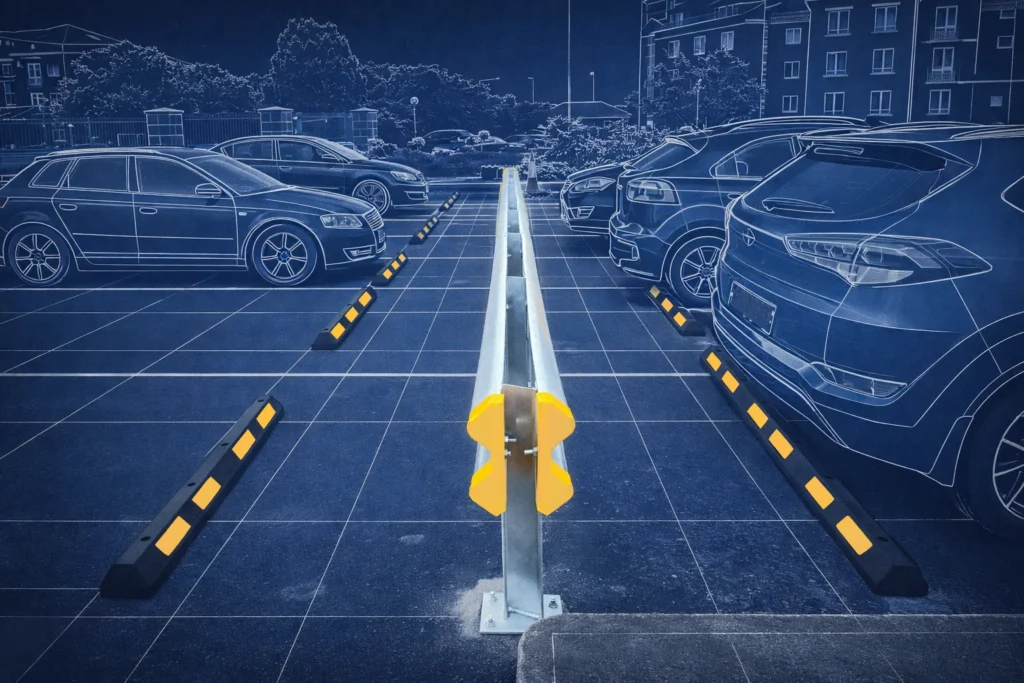
For retail specifically, the customer-facing dimension of car park safety is particularly significant. A customer who damages their vehicle on an unprotected lamp post, collides with a rigid post while parking, or witnesses a near-miss between a pedestrian and a delivery vehicle in the service yard becomes a potential liability claimant and a reputational risk. The Lamp Post Wrap’s ability to protect both infrastructure and vehicles simultaneously – while adding high-visibility reflective bands that genuinely improve driver awareness – addresses both the safety and the customer experience dimension of car park management.
GH18 Wheel Stoppers in customer car parks prevent the common scenario of vehicles rolling forward into landscaped verges, shopping cart corrals, or adjacent parked vehicles. Their recycled rubber construction eliminates the chipped-concrete aesthetic failure mode that concrete kerbs exhibit, maintaining the visual quality of the car park environment over the long term.
6.2 Logistics and Distribution: High-Volume Traffic Management
For Irish logistics operators, distribution centers, and third-party logistics providers, car park and service yard safety infrastructure has direct operational consequences. An HGV wheel stop correctly deployed at every loading bay position ensures consistent, safe vehicle positioning – reducing the incident rate of driver cab-to-dock-plate misalignment, minimizing damage to dock levellers, and eliminating the risk of vehicles rolling back from the dock.
Speed management in a busy distribution center service yard – where HGVs, light commercial vehicles, forklift trucks, and pedestrians may all be present simultaneously – requires a layered approach. Speed ramps on access roads reduce vehicle speed before vehicles enter the service area. Convex mirrors at blind corners between warehouse units provide advanced awareness of approaching traffic. Flexible traffic kerbs define one-way routes and pedestrian exclusion zones. Flexi parking posts mark bay limits and sign posting routes. These products work as a system, not as isolated items.
The Cable Hose Ramp is particularly relevant for Irish logistics facilities that have deployed EV charging infrastructure or where temporary power connections for refrigerated trailer units cross service yard surfaces. Protecting these connections from vehicle impact is both a safety requirement and an asset protection measure.
6.3 Healthcare and Pharmaceutical: Visitor Safety and Infrastructure Integrity
Hospitals, primary care centers, and pharmaceutical manufacturing and distribution facilities in Ireland operate car parks and service yards under significantly heightened scrutiny. Visitor car parks at acute hospitals are in continuous high-density use, with a visitor population that includes elderly patients, individuals with mobility limitations, and people in psychological distress – demographics for whom the consequences of a car park incident are particularly serious.
The GH18 Wheel Stopper and the Lamp Post Wrap address two of the most common physical hazards in hospital car parks: uncontrolled vehicle roll and unprotected structural elements. Rubber Corner Guards on car park pillar corners reduce the incidence of vehicle damage – and, importantly, reduce the structural damage to reinforced concrete pillars that carries long-term maintenance and structural engineering implications.
For pharmaceutical manufacturing sites, where HSA and Pharmaceutical Standards of Ireland audits examine the physical environment as part of broader compliance assessments, a visibly well-managed car park and service yard – with appropriate speed management, vehicle restraints, and visibility aids – contributes to the overall compliance narrative.
6.4 Hospitality: First Impressions and Operational Safety
Hotels, large restaurants, and event venues face a distinctive car park safety challenge: the need to balance visual aesthetics with operational safety. A hotel car park is a guest-facing environment in which bulky safety infrastructure can undermine the quality impression the property seeks to create.
The Flexi Parking Post’s clean, paint-free finish and signage-ready design is particularly relevant here. It provides effective bay marking and vehicle guidance without the visual heaviness of painted steel or concrete kerbs. The Flexible Traffic Kerb’s availability in a Red Brick color finish allows it to complement landscaped car park designs rather than contrasting with them. The outdoor convex mirror in orange polypropylene is a recognisable safety fixture that reads as professionally installed rather than improvised.
For event venues with temporary operations – outdoor festivals, concert venues, agricultural shows – the Cable Hose Ramp provides a deployable, redeployable solution for protecting temporary electrical and sound system cable runs across vehicle access routes.
6.5 Manufacturing and Industrial Estates
Multi-tenant industrial estates present a specific car park safety governance challenge: the responsibility for common areas – car parks, access roads, service yards – typically falls on the estate management body rather than on individual tenants, creating a procurement context in which cost-effectiveness and broad applicability are the primary criteria.
For estate managers, the GH40 Speed Ramp and Speed Cushion provide a scalable, cost-effective vehicle speed management solution that is appropriate across the full range of vehicle types present on a mixed industrial estate. The Galvanised Bollard – explicitly positioned as a budget-conscious infrastructure option – allows estate managers to demarcate pedestrian areas, protect building entrances, and mark utility access points without the maintenance overhead of painted steel alternatives.
7. Strategic ROI & Comparative Analysis
7.1 Rubber vs. Concrete: Wheel Stops and Speed Ramps
The following comparison addresses the total cost of ownership across a ten-year operational period for rubber and concrete wheel stop and speed ramp alternatives, based on the operational characteristics of each material in an Irish environment.
Wheel Stops – Rubber (SVL GH18) vs. Concrete
| Metric | Rubber (SVL GH18) | Concrete |
|---|---|---|
| Initial Product Cost | Moderate | Lower |
| Installation Method | Pre-drilled, coach screw | Specialist ground works |
| Installation Time | Under 1 hour/unit | Half day+ per unit |
| Corrosion Resistance | Complete | None (rebar risk) |
| Salt/Freeze-Thaw Resistance | Excellent | Poor |
| Vehicle Damage Risk | Minimal | Moderate to high |
| Replacement Frequency (10yr) | Low | High |
| End-of-Life Removal | Simple unscrewing | Concrete breaking, waste disposal |
| Compliance (Uneven Surfaces) | Excellent | Poor |
| 10-Year TCO Estimate | Lower | Higher |
Speed Ramps – Rubber (SVL GH40) vs. Asphalt/Concrete
| Metric | Rubber (SVL GH40) | Asphalt/Concrete |
|---|---|---|
| Initial Cost | Moderate | Higher (requires specialist laying) |
| Relocation Flexibility | High (unscrewable) | None |
| Retroreflectivity | Integrated cats eye | Requires separate studs |
| Recycled Material | Yes (recycled tyres) | No |
| Maintenance Required | Minimal | Periodic sealant/repair |
| Surface Conformity | Good | Fixed |
| HGV Compatibility | Confirmed | Often not specified |
| 10-Year TCO Estimate | Competitive to lower | Higher |
7.2 Flexible Posts vs. Rigid Steel Bollards
| Metric | Flexi Parking Post (SVL) | Rigid Painted Steel |
|---|---|---|
| Impact Response | Flex and recover | Permanent deformation |
| Post-Impact Replacement | Not required (typically) | Required |
| Repainting Required | No | Yes (periodic) |
| Installation | Surface bolt-down | Same |
| High-Traffic TCO | Lower | Higher |
| Signage Capability | Integrated | Requires separate hardware |
7.3 Lamp Post Wrap vs. Concrete/Steel Ground Works
| Metric | Lamp Post Wrap (SVL) | Concrete Surround / Steel Kerb |
|---|---|---|
| Ground Works Required | None | Yes |
| Installation Time | Minutes | Half to full day |
| Suitable for Membrane Surfaces | Yes | Typically not |
| Retroreflectivity | Diamond-grade integrated | Requires additional marking |
| Pole Diameter Compatibility | 50–210mm (adjustable) | Specific to design |
| Removal/Relocation | Simple | Demolition and reinstatement |
| TCO Over 5 Years | Significantly lower | Significantly higher |
These comparisons establish a consistent pattern: SVL’s rubber and polymer-based car park safety equipment range delivers competitive or superior total cost of ownership relative to traditional material alternatives across most installation contexts. The advantage is most pronounced in environments with high traffic volume, in locations with challenging substrate conditions, and in operations where relocation or reconfiguration flexibility is valued.
8. Buying Guide & Decision Framework
8.1 Key Specification Criteria for Procurement
Vehicle Class Matching
The single most important specification decision in purchasing wheel stops is matching the product to the vehicle class it will be managing. The GH18 Wheel Stopper is designed for passenger cars and light vans; the HGV Wheel Stop is engineered for larger commercial vehicles. Using a car-class wheel stop in a loading bay that receives HGVs will result in product displacement, structural damage, and non-compliance with the risk assessment requirement to provide adequate engineering controls for the hazard.
Indoor vs. Outdoor Designation
For convex mirrors, the indoor/outdoor distinction is not merely a design preference – it is a material and construction specification. SVL’s outdoor mirrors incorporate UV-stable materials, an orange high-visibility frame, and a glare-reducing mini visor designed for weather exposure. The indoor Vista Flex models are optimized for the different optical and mounting requirements of enclosed environments. Specifying an outdoor-designated mirror for an indoor application, or vice versa, will compromise either the longevity or the optical performance of the installation.
Mirror Diameter and Viewing Distance
A convex mirror installation without due regard to the relationship between mirror diameter and viewing distance is an under-specified safety control. As a practical guideline: the 300mm outdoor mirror is suited to driveways and pedestrian-scale blind spots at close range; the 400mm and 600mm outdoor models are appropriate for car park entrances and loading bay approaches respectively; the 400mm indoor Vista Flex addresses tighter stockroom and aisle corners; the 450mm model addresses main aisle junctions and mixed-traffic intersections.
Surface Substrate Verification
For all bolted-down products – wheel stops, speed ramps, flexible kerbs, bollards, parking posts – confirming that the substrate is a solid concrete surface of adequate strength is a prerequisite for correct installation performance. Where there is doubt about substrate quality, SVL can provide guidance on appropriate fixing specifications for different surface conditions.
Temporary vs. Permanent Installation Requirements
The Cable Hose Ramp and Speed Cushion are both explicitly suited for temporary deployment as well as permanent installation. Organizations managing recurring events, temporary construction works, or seasonal operational changes should factor deployment and redeployment flexibility into their specification – rubber-based products with pre-drilled bolt fixing can be removed and redeployed with minimal tooling.
8.2 The SVL Advantage in the Irish Market
SVL operates from Dublin 12, Western Industrial Estate, placing the company at the logistical center of the Irish market. This geographic position provides practical advantages for Irish procurement: stock availability, short lead times, and the ability to consult directly with SVL’s team on site-specific requirements before committing to an order.
SVL’s product range spans the full spectrum of car park safety requirements – from the smallest indoor convex mirror to full HGV wheel stops and large-format speed cushions. This breadth means that procurement teams can source the entirety of a car park safety infrastructure programme from a single supplier, reducing the administrative overhead of managing multiple vendor relationships and ensuring dimensional and quality compatibility across products that will operate in the same environment.
The availability of an enquiry-led product engagement model means that SVL’s team can support specification decisions that require site-specific judgement – helping customers identify the correct mirror size for a specific blind corner, the appropriate kerb color for a specific site aesthetic, or the most suitable speed management solution for a shared public/commercial transport access route.
9. Future Trends & Industry Outlook for Ireland
9.1 The EV Transition and Car Park Infrastructure
Ireland’s national commitment to electric vehicle adoption – targeting 45% of all passenger vehicles being EVs by 2030 under the National EV Strategy – is already creating visible changes in commercial car park design. EV charging points, charge point cabling, and in-ground cable routing are becoming standard features of commercial car parks, retail parks, and logistics facility car parks across Ireland. This infrastructure transition creates new demand for cable protection products: the Cable Hose Ramp is directly positioned to address the need to protect EV charging cables at vehicle crossing points, particularly in retrofitted car parks where above-ground cable routing is the most cost-effective installation approach.
9.2 HSA Strategy 2025-2027 and Enforcement Trajectory
The HSA’s Strategy Statement for 2025–2027 places renewed emphasis on measurable outcomes, enhanced resource efficiency, and proportionate enforcement. The 2024 Annual Report confirmed 34 workplace fatalities in that year – a figure that the HSA described as “a stark reminder of why we must continue to invest in prevention, education and enforcement.” The trajectory is clear: the regulatory bar for physical engineering controls in Irish workplaces is not static. Organizations that have relied on administrative controls (signage, rules, induction training) without commensurate engineering controls will face increasing scrutiny as the HSA’s inspection programmes intensify.
9.3 Sustainable Procurement and Recycled Materials
Sustainability criteria are increasingly incorporated into Irish procurement frameworks – both public sector tendering (under the Government’s Green Public Procurement Policy) and private sector corporate responsibility commitments. Several products in SVL’s range – notably the GH18 Wheel Stopper, HGV Wheel Stop, GH40 Speed Ramp, and Speed Cushion – incorporate recycled rubber as a primary material input. This recycled content represents a genuine circular economy credential: the material has completed a prior service life as vehicle tyres and is being given a second productive life as safety infrastructure. For procurement officers required to demonstrate sustainability credentials in their supply chains, specifying recycled rubber products from SVL represents a quantifiable, evidenceable contribution to circular economy targets.
9.4 The Data-Driven Facilities Manager
The emergence of smart facility management platforms – including CAFM (Computer-Aided Facility Management) systems, IoT-enabled monitoring, and integrated H&S management software – is changing how Irish facilities managers document and justify their infrastructure decisions. The shift towards data-driven capital planning means that lifecycle cost data, maintenance records, and incident statistics will increasingly be used to prioritise infrastructure investment. SVL’s product range – with its documented specifications, compliance credentials, and established installation track record – is well-positioned to be integrated into these data frameworks as quantifiable, specification-certain asset items.
9.5 Urban Densification and Multi-Storey Car Parks
Ireland’s continued urban densification, particularly in Dublin, Cork, Limerick, and Galway, is driving increased construction and refurbishment of multi-storey and underground car parking facilities. These environments present specific safety infrastructure challenges: tighter turning radii, lower light levels, shared pedestrian/vehicle use, and restricted access for ground works. SVL’s range of products that require no excavation or ground works – the Lamp Post Wrap, the Rubber Corner Guard, the Vista Flex convex mirrors, and surface-mounted rubber kerbing – are specifically well-suited to the multi-storey and underground car park environment, where the cost and disruption of ground works is disproportionately high.
10. Conclusion
The thirteen products that compose SVL’s car park safety equipment range are not a random collection of traffic management commodities. They are a coherent, engineering-grounded system of interventions – spanning visibility enhancement, speed management, vehicle restraint, infrastructure protection, and cable management – that together address the full spectrum of physical hazards present in Irish commercial and industrial car parks, service yards, loading bays, and warehouse access areas.
The strategic case for investing in this infrastructure rests on four pillars that Irish business owners, H&S managers, and procurement officers should weigh carefully.
Legal compliance: The Safety, Health and Welfare at Work Act 2005 and the HSA’s Workplace Transport Safety framework create explicit engineering control requirements. Physical products are the evidence of compliance – not policies or induction programmes.
Total cost of ownership: Across every product category, rubber and polymer-based safety infrastructure delivers lower ten-year total cost than traditional concrete and steel alternatives, primarily through elimination of maintenance, repair, and replacement cycles.
Operational performance: Speed management, vehicle positioning, and blind-spot elimination are not abstract safety ideals – they are direct contributors to operational throughput, incident reduction, and loading bay efficiency.
Regulatory trajectory: The HSA’s 2025–2027 strategy, combined with the HSA’s 2024 enforcement record, indicates that the intensity of workplace safety scrutiny in Ireland will continue to increase. Organizations that invest in engineered controls now are not merely complying with today’s expectations; they are positioning themselves ahead of the enforcement environment of tomorrow.
SVL (Store Vision Ltd) occupies a distinctive position in the Irish safety infrastructure market: a Dublin-based supplier with a comprehensive, specification-ready range of car park safety products, backed by a direct advisory service for procurement teams who require site-specific guidance. For facilities managers, H&S directors, procurement officers, and operations leaders seeking to bring the physical infrastructure of their sites into alignment with both HSA expectations and best-in-class operational practice, SVL’s car park safety equipment range represents a well-evidenced, cost-effective, and durably engineered starting point.
The car park is the first thing visitors see. The loading bay is where the business meets its supply chain. The warehouse aisle is where safety performance is measured in daily outcomes. These spaces deserve an infrastructure investment commensurate with what is at stake.
11. References
SVL Product Pages
- SVL – Car Park Safety Equipment Category: https://svl.ie/product-category/car-park-safety-equipment/
- SVL – 400mm Vista Flex Indoor Convex Mirror: https://svl.ie/product/400mm-vista-flex-indoor-convex-mirror-ireland/
- SVL – 450mm Vista Flex Indoor Convex Mirror: https://svl.ie/product/450mm-vista-flex-indoor-convex-mirror-ireland/
- SVL – Cable Hose Ramp: https://svl.ie/product/cable-hose-ramp/
- SVL – Convex Mirror (Full Range): https://svl.ie/product/convex-mirror/
- SVL – Flexi Parking Posts: https://svl.ie/product/parking-posts/
- SVL – Flexible Traffic Kerb: https://svl.ie/product/flexible-traffic-kerb/
- SVL – Galvanised Bollard: https://svl.ie/product/galvanised-bollard/
- SVL – GH18 Wheel Stopper: https://svl.ie/product/gh18-wheel-stopper/
- SVL – GH40 Speed Ramp: https://svl.ie/product/gh40-speed-ramp/
- SVL – HGV Wheel Stop: https://svl.ie/product/hgv-wheel-stop/
- SVL – Lamp Post Wrap: https://svl.ie/product/lamp-post-wrap/
- SVL – Rubber Corner Guard: https://svl.ie/product/rubber-corner-guard/
- SVL – Speed Cushion: https://svl.ie/product/speed-cushion/
Regulatory and Standards References
- Health and Safety Authority Ireland – Work Related Vehicle Safety: https://www.hsa.ie/eng/vehicles_at_work/work_related_vehicle_safety/
- Health and Safety Authority Ireland – Workplace Transport Safety: https://www.hsa.ie/eng/vehicles_at_work/workplace_transport_safety/
- Health and Safety Authority Ireland – Workplace Traffic Management: https://www.hsa.ie/eng/vehicles_at_work/transport_safety_guidance_resources/workplace_traffic_management/
- Health and Safety Authority Ireland – Warehousing Safety: https://www.hsa.ie/eng/Vehicles_at_Work/Workplace_Transport_Safety/Warehousing_Safety/
- Health and Safety Authority Ireland – 2024 Annual Report (Published July 2025): https://www.hsa.ie/eng/news_events_media/news/press_releases_2025/health_and_safety_authority_publishes_2024_annual_report_highlighting_strengthened_enforcement_effective_collaboration_and_targeted_outreach_programmes.html
- Safety, Health and Welfare at Work Act 2005 (Republic of Ireland), Sections 8 and 19.
- EU Directive 92/58/EEC – Minimum requirements for safety and/or health signs at work.
- European SRT 48 Standard – Pendulum Test for Slip Resistance.
SVL Website and Company Information
- SVL (Store Vision Ltd) – Website: https://svl.ie
- SVL – LinkedIn: https://www.linkedin.com/company/store-vision-ltd
- SVL – Contact: Unit 231 Holly Road, Western Industrial Estate, Naas Road, Dublin 12, Ireland. Tel: +353 01 257 2260.
This article was prepared by SVL (Store Vision Ltd) for educational and informational purposes. All product specifications are sourced directly from SVL product pages. All regulatory references are derived from publicly available HSA and legislative sources. This article does not constitute legal or professional H&S advice; organizations should consult a qualified H&S professional for site-specific compliance assessments.