
By SVL (Store Vision Ltd) – Ireland’s Premier Authority on Warehouse Safety Solutions & Impact Protection.
The logistics, manufacturing, and warehousing sectors in Ireland have experienced a dramatic evolution over the past half-decade. Fueled by the post-Brexit requirement for increased local inventory and the relentless surge in e-commerce, the demand for industrial space has reached unprecedented levels. From Dublin’s M50 corridor to strategic hubs in Cork and along the M1, facilities are operating at maximum capacity.
However, increased operational density inevitably creates higher risk profiles. With faster forklift movements and crowded aisles, the margin for error has effectively disappeared. For Facility Directors and EHS Officers, managing safety is no longer a “tick-box” exercise for insurers – it is a critical operational necessity.
This guide outlines the 2025 standard for keeping Ireland’s supply chain moving safely.
- 1. The State of Safety 2025: HSA Compliance & The Law
- 2. The ROI of Material Science: Polymer vs. Steel
- 3. Zone 1: Fortifying the Loading Bay
- 4. Zone 2: Protecting Racking & Assets
- 5. Zone 3: Pedestrian Segregation & Traffic Management
- 6. Sector Focus: Hygiene, Pharma & Cold Storage
- 7. The SVL Methodology: Site Surveys vs. Catalogues
- Conclusion: Investing in Zero Harm
1. The State of Safety 2025: HSA Compliance & The Law
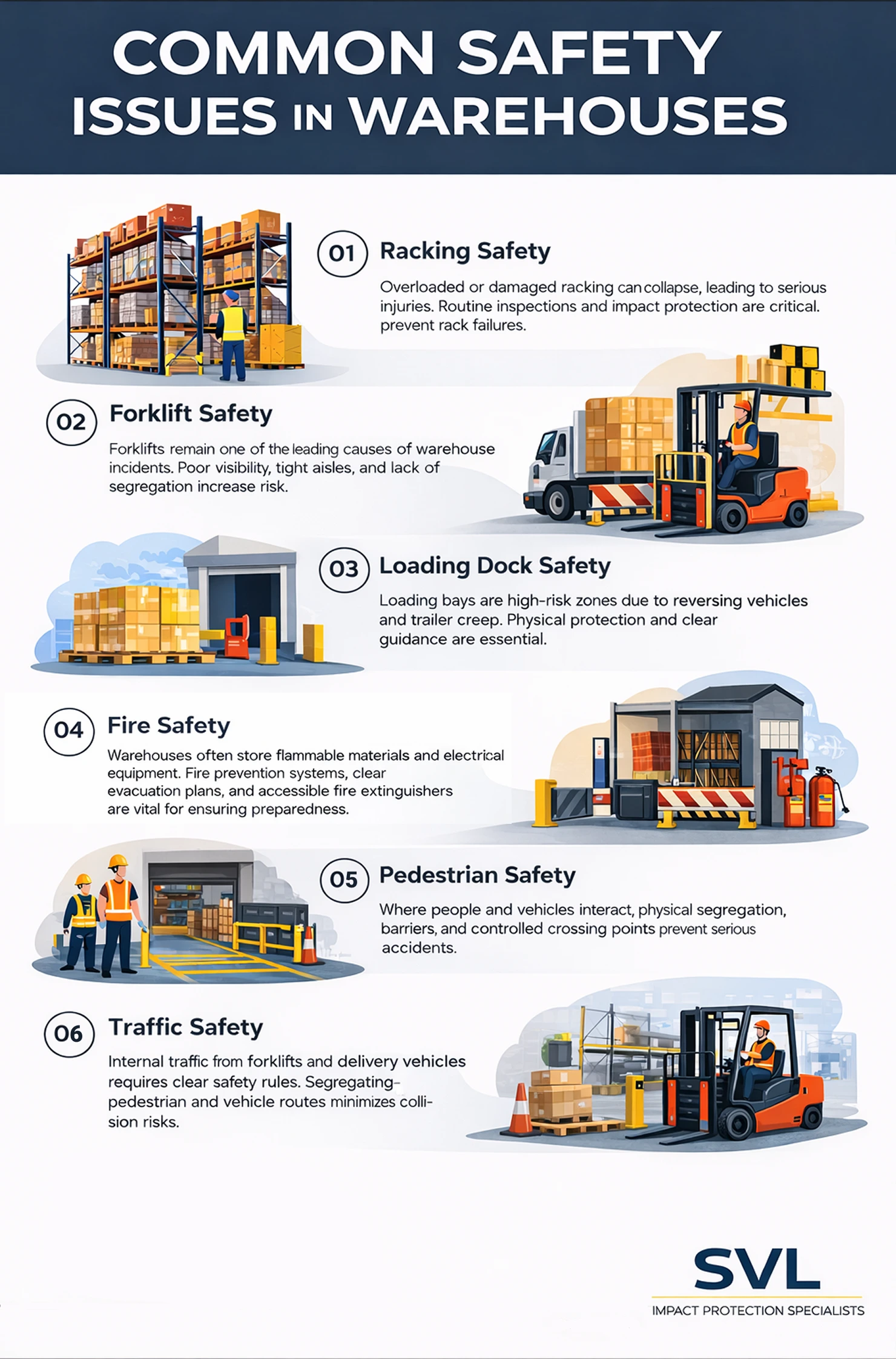
In the current Irish regulatory climate, treating workplace transport safety as a secondary concern is a liability. The Health and Safety Authority (HSA) has explicitly targeted the segregation of vehicles and pedestrians as a primary inspection focus.
The Legislative Mandate
Under the Safety, Health and Welfare at Work Act 2005, specifically Section 8, employers are legally mandated to design and maintain a safe workspace. This places the burden of responsibility squarely on Directors and Safety Officers.
For Logistics Managers, relying on “common sense” is not a valid legal defense. Following an incident – such as a forklift collision or racking failure – investigators will not ask if you warned your drivers. They will demand to know:
- What engineering controls were physically installed?
- Was a comprehensive risk assessment conducted?
- Did you rely on administrative lines (paint) when physical barriers were reasonably practicable?
Cross-Border Standards (HSE & HSA)
For SVL clients operating across both the Republic of Ireland and the UK, standards are converging. The UK’s Health and Safety Executive (HSE) maintains equally rigorous expectations. Whether your facility is located in Dublin 12 or Belfast, the benchmark for impact protection has risen universally.
The EHS Officer’s Burden
We recognize the pressure on modern EHS Officers. Managing a 24/7 facility involves juggling training, fire safety, and compliance. The fear of a “near miss” escalating into a fatality is a constant stressor. Given that forklifts have poor sightlines and weigh significantly more than passenger cars, relying on driver concentration alone is insufficient. Robust physical segregation is the only way to mitigate human error.
The Cost of Negligence: Investing in barriers is often scrutinized, but the cost of an accident dwarfs the price of protection. A single racking collapse results in direct repair costs, stock loss, operational downtime, legal fees, and reputational ruin. SVL solutions are designed to eliminate these variables.
2. The ROI of Material Science: Polymer vs. Steel
The industry is currently debating the merits of traditional materials versus modern engineering. SVL advocates for advanced material science, specifically the shift from steel to polymer.
The Flaw in the Steel “Deflection” Model
Traditionally, steel was the default choice. However, steel is rigid. When a 4-tonne forklift strikes a steel barrier, the energy is not absorbed; it is transferred directly to the floor fixings.
- The Consequence: The barrier stops the vehicle, but the anchor bolts are ripped from the concrete. The barrier is permanently bent, and the floor slab is cracked.
- The Cost: You are left with a damaged asset and an expensive civil engineering repair job.
The Polymer “Absorption” Advantage
SVL’s polymer safety barriers utilize kinetic energy absorption. The material is engineered to flex upon impact, cushioning the blow before returning to its original shape.
- The Result: The energy is dissipated within the barrier, not the floor. The concrete slab remains intact, the barrier needs no repair, and vehicle damage is minimized.
Floor Preservation & OpEx Savings
Your warehouse floor is your most expensive asset. Repairing “blown out” concrete disrupts operations and requires cure time. Furthermore, polymer barriers eliminate the “Hidden OpEx” of steel maintenance. Unlike steel, which rusts and requires annual painting (especially in wash-down areas), polymer is self-colored and non-corrosive. It requires zero maintenance beyond a simple wipe-down.
3. Zone 1: Fortifying the Loading Bay
The loading bay is the “mouth” of your facility and a high-risk zone. With 40-tonne articulated lorries reversing into tight spaces under time constraints, the potential for structural damage is immense.
Mitigating Heavy Vehicle Risks
- Impact Damage: Standard rubber bumpers frequently fail to protect the dock wall from the kinetic energy of a reversing truck. This leads to crushed concrete and bay downtime.
- Trailer Creep: As forklifts load a trailer, momentum can cause the vehicle to inch away from the dock, creating a dangerous gap that can tip a forklift.
The SVL Defence System
We move beyond generic solutions to engineer out risk:
- Polymer Bollards (Door Track Protection): We replace rigid steel bollards – which rip out of the ground when hit – with rotating polymer bollards. These absorb impacts and guide the truck, protecting both the vehicle and the yard surface.
- Wheel Guides: Robust alignment guides ensure drivers hit the mark every time, preventing damage to the building fabric.
- Advanced Dock Buffers: We utilize friction-reducing materials that slide with the trailer’s vertical movement, significantly outlasting standard rubber blocks.
4. Zone 2: Protecting Racking & Assets
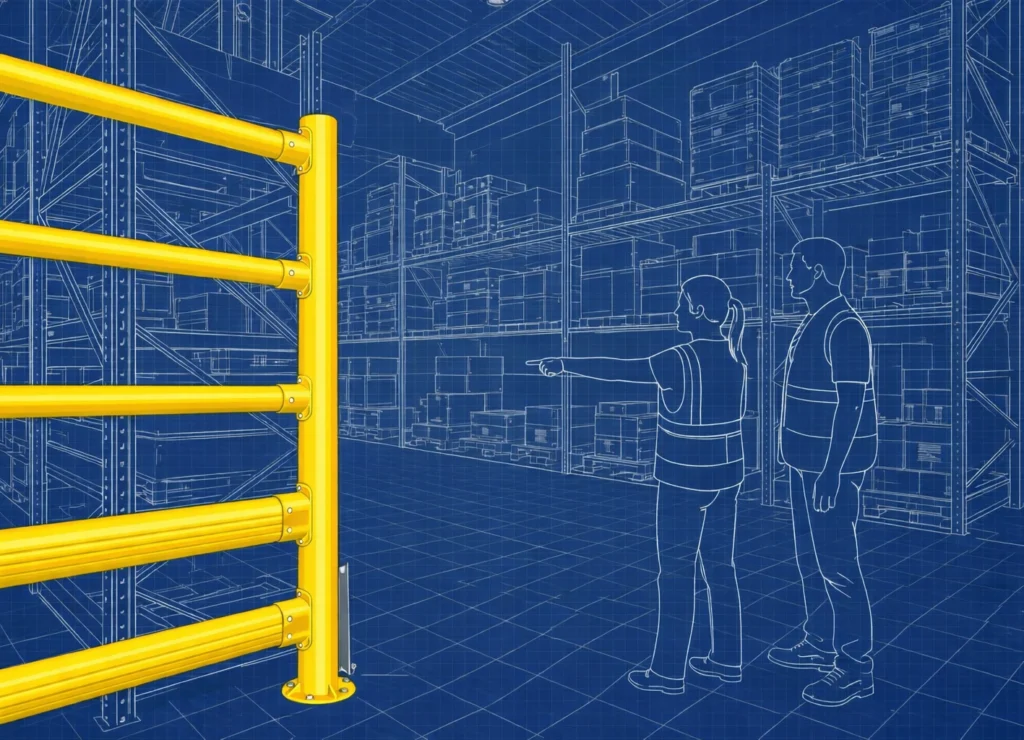
In the storage zone, the risk shifts to agile, fast-moving forklifts. A single impact on a critical upright can trigger a catastrophic racking collapse – a nightmare scenario for any Logistics Manager.
Rack End Protection
The ends of racking aisles are high-frequency impact zones due to the turning circle of forklifts. Relying on painted lines or thin steel hoops is a gamble. SVL installs double-rail Polymer Safety Barriers combined with spinning bollards at high-friction corners. This deflects the vehicle away from the rack rather than stopping it dead, preserving the structural integrity of your storage system.
Cold Storage Engineering
For Ireland’s agri-food sector, cold storage presents unique challenges. Steel becomes brittle and paint flakes in sub-zero temperatures. SVL provides specialized polymer solutions engineered to remain flexible and food-safe at temperatures as low as -30°C, ensuring compliance with BRC and FDA audits.
5. Zone 3: Pedestrian Segregation & Traffic Management
Separating people from moving machinery is the single most effective control measure required by HSA Workplace Transport Safety Management guidelines.
The “Walkway” Fallacy
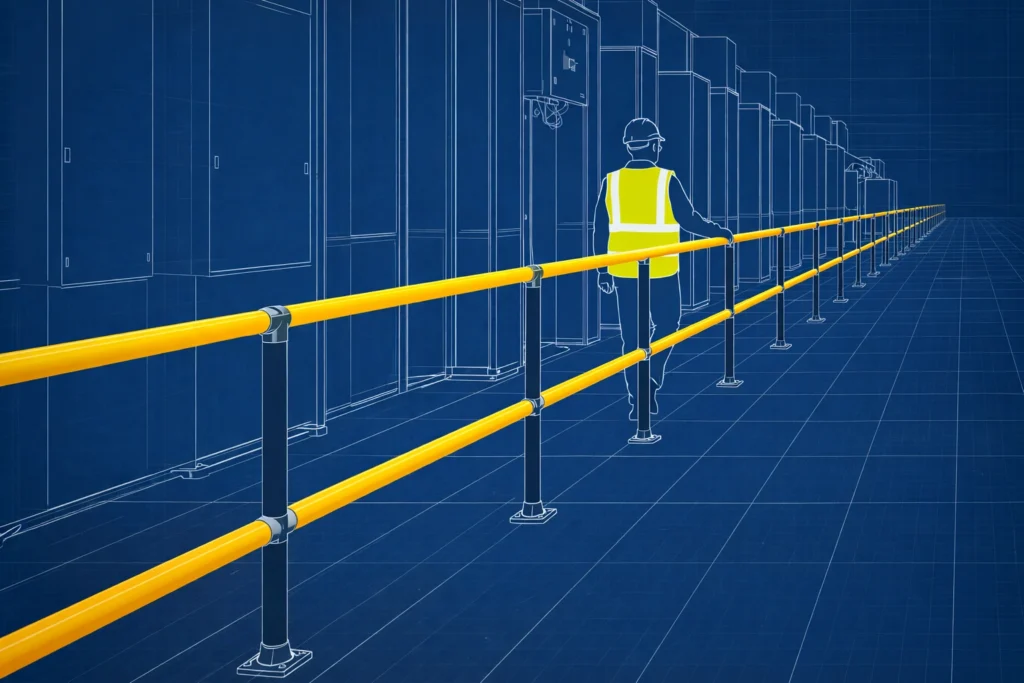
Many warehouses still rely on yellow floor paint to define walkways. Paint is an administrative control, not a physical one. It offers zero protection against brake failure or driver distraction. SVL implements a “force field” concept using physical barriers.
Engineering Safe Behaviour
- Impact-Rated Handrails: Our pedestrian barriers prevent forklifts from penetrating walkways. Unlike cold steel, they are tactile and ergonomic, encouraging staff usage.
- The “Conscious Pause” (Safety Gates): Crossing points are critical danger zones. We install self-closing gates that force pedestrians to stop and open the gate. This physical action creates a moment of pause, forcing the user to check for traffic before crossing.
For the EHS Officer, this system proves due diligence, demonstrating that you have gone beyond minimum requirements to engineer a fail-safe environment.
6. Sector Focus: Hygiene, Pharma & Cold Storage
Ireland’s status as a global hub for Pharmaceuticals and Agri-Food necessitates facilities that exceed standard logistics requirements. In these sectors, protection must be hygienic as well as strong.
The Contamination Risk of Steel
In food production or clean-room environments, rust and flaking paint from damaged steel barriers constitute a “foreign body contamination” risk. This can lead to immediate non-conformance during audits.
The Hygienic Polymer Solution
SVL distributes HACCP-friendly barriers. The polymer is non-porous, resistant to chemical wash-downs, and does not harbour bacteria. Because the high-visibility colour is moulded throughout the material, there is no paint to chip or flake, ensuring a sterile aesthetic that satisfies auditors.
7. The SVL Methodology: Site Surveys vs. Catalogues
Buying safety barriers from a catalogue is a dangerous “commodity” approach. Without expert input, you risk miscalculating turning circles, floor depth, or stopping distances, leaving the liability entirely on your shoulders.
The SVL “Boots on the Ground” Approach
SVL operates as a solution provider, not a product catalog. Our process includes:
- On-Site Survey: We analyze traffic flows, driver behavior, and blind spots.
- Bespoke Design: We utilize CAD drawings to create a traffic management plan that integrates seamlessly with your operations.
- Targeted Specification: We optimize your budget by deploying heavy-duty protection where risks are highest and flexible solutions where appropriate.
Installation & Certification
A barrier is only as good as its installation. Poor fixing by general “handymen” compromises safety. SVL’s installation teams are Safe Pass holders and trained experts. We ensure every barrier is installed to manufacturer tolerances, providing you with full certification and peace of mind.
Conclusion: Investing in Zero Harm
As 2025 progresses, the kinetic energy within Irish warehouses is increasing. You have two choices for funding safety: pay upfront for a scientifically engineered protection system, or pay later through accident investigations, HSA fines, and operational downtime.
SVL exists to help you choose the investment route. We alleviate the burden on the EHS Officer by providing the data, design, and installation expertise required to achieve a “Best in Class” safety standard.
Don’t wait for a near-miss to become an accident. Contact SVL today to secure your facility.