
By SVL (Store Vision Ltd)
- 1. Executive Summary: Building a Resilient Industry
- 2. Company Profile: The Evolution of SVL
- 3. The Irish Industrial Landscape
- 4. The Product Ecosystem: Engineered for Energy Absorption
- 5. The Physics of Impact: Flexible vs. Rigid
- 6. Market Comparison: Commodities vs. Solutions
- 7. Strategic Opportunities & Market Gaps
- 8. Client Scenarios & Use Cases
- 9. The P.A.C.E. Procurement Framework
- 10. Future Outlook: Automation & Sustainability
- 11. Technical Deep Dive: Anchor Failure Modes
- 12. Sector Focus: Data Centers & Contamination Control
- 13. Facility Audit Guide: Identifying Risks
- 14. ROI Analysis: The True Cost of Downtime
- 15. Cross-Border Compliance (Ireland & UK)
- 16. Conclusion: Future-Proofing Irish Infrastructure
- References
1. Executive Summary: Building a Resilient Industry
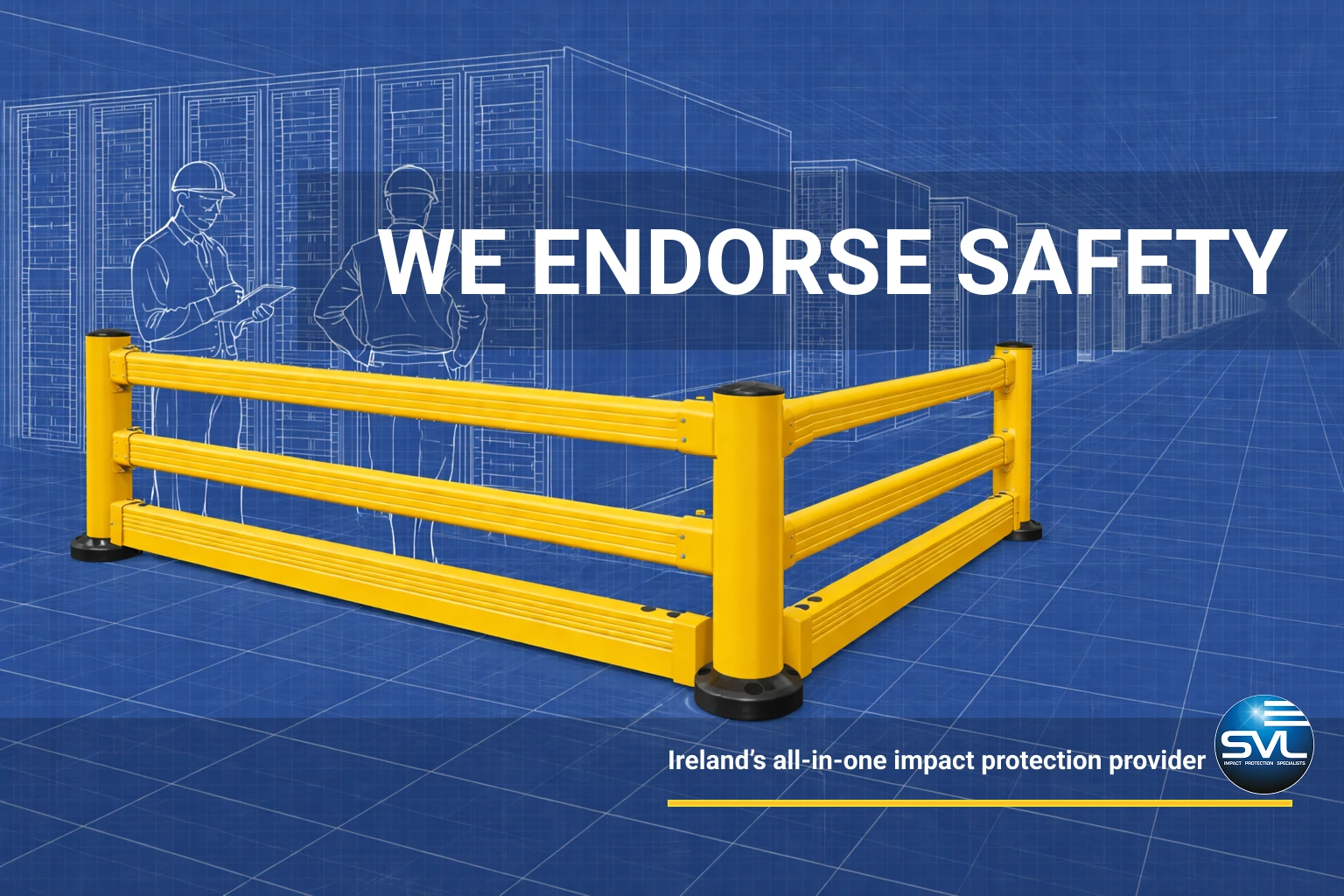
Ireland is currently navigating a unique industrial contradiction. While the nation has firmly established itself as the digital hub of Europe – hosting a dense concentration of hyperscale data centers and pharmaceutical giants – the physical infrastructure protecting these trillion-euro assets is often reliant on outdated safety specifications.
With the lifting of the moratorium on new power connections for data centers in the Dublin region, we anticipate a surge in new construction and facility retrofitting. This expansion requires a standard of operational rigour that traditional steel fabrication cannot provide.
This guide serves as a strategic resource for facility directors, health and safety leads, and procurement teams. Our stance is clear: Impact protection systems are not generic commodities to be selected from a catalog; they are critical engineering controls essential for maintaining Operational Continuity. By pivoting from simple metal fabrication to energy-absorbing polymer technology, SVL bridges the gap between basic regulatory compliance (HSA) and genuine asset preservation.
2. Company Profile: The Evolution of SVL
2.1 From Retail Roots to Industrial Safety
Our trade name, “Store Vision,” hints at our history in the high-footfall retail sector. However, our operational focus has transformed. Today, SVL is Ireland’s premier authority on impact protection and industrial damage prevention.
We do more than simply supply hardware. We audit facilities, specify technical solutions, and install comprehensive safety ecosystems. Through partnerships with global innovators, we bring patented safety technologies to the Irish market that local steel fabricators cannot replicate.
2.2 Our Value Proposition
Our engagement model is built on three foundational pillars:
- Certified Engineering: We provide systems with verified energy absorption ratings (Joules), offering scientific certainty rather than assumed strength.
- Total Cost of Ownership (TCO): We prioritize the elimination of long-term OpEx costs – such as floor repairs, repainting, and barrier replacements – justifying the initial investment in engineered polymers.
- Brand Integrity: For high-visibility clients in retail and data hosting, aesthetics are crucial. Our systems maintain a pristine “Day 1” appearance without rusting or flaking.
2.3 The Consultative Audit
We avoid the sales tactics of “over-specifying” (selling unnecessary bulk) or “under-specifying” (installing insufficient protection). Instead, we act as impartial auditors, matching protection ratings specifically to the weight and velocity of your facility’s traffic.
3. The Irish Industrial Landscape
3.1 Europe’s Data Hosting Capital
The “Dublin Metro” area operates under some of the most stringent facility construction standards in Europe. As grid connection restrictions ease, a backlog of critical projects is set to commence.
- The Risk: Unlike general warehousing, data centers house static, high-value assets. A forklift puncturing a server rack or cooling unit is not a minor loss; it is a multi-million euro incident involving strict Service Level Agreement (SLA) penalties.
- The Hygiene Factor: Data halls demand clinical air quality. Traditional steel barriers crack concrete upon impact, releasing silica dust – a contaminant that is unacceptable in these environments.
3.2 The Shift in Retail Logistics
The “Big Box” retail model has evolved. Back-of-house areas have transformed into high-velocity Click & Collect fulfillment centers. This shift has increased traffic density in confined spaces, significantly raising the risk of vehicle-pedestrian accidents.
3.3 Regulatory Compliance (HSA & UK HSE)
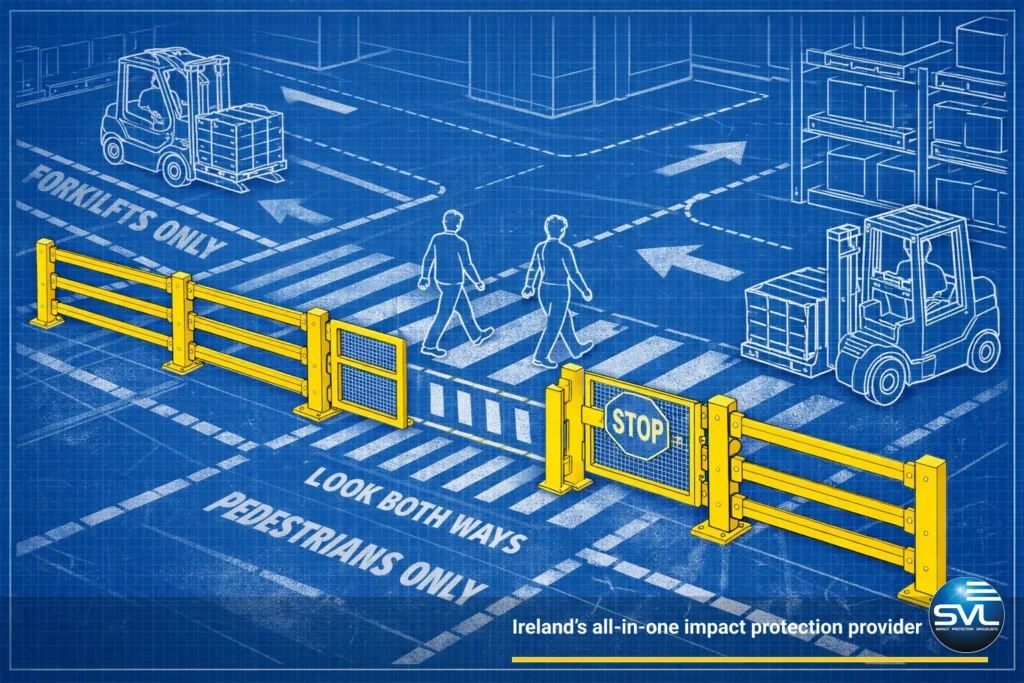
We closely track the Health and Safety Authority (HSA) guidelines. There is a growing emphasis on robust Traffic Management Plans. Simply painting yellow lines on the floor is increasingly viewed as insufficient. Physical segregation via barriers is becoming the expected standard for “reasonably practicable” risk reduction.
4. The Product Ecosystem: Engineered for Energy Absorption
We categorize our product suite by its ability to manage kinetic energy, rather than just product type.
4.1 Polymer Traffic Barriers
The Solution: SafeStop & Traffic Barrier Systems. The Technology: Utilizing a proprietary polymer blend, these rails flex on impact before returning to their original form. Why It Matters:
- Shock Absorption: The barrier absorbs the force, protecting the floor anchors from being ripped out (“concrete blowout”).
- Hygiene: The material is self-coloured and non-corrosive, making it ideal for food and pharma sectors.
- Modularity: Damaged sections can be swapped without the need for hot works (welding) or drilling new core holes.
4.2 Bollards & Perimeter Defense
The Solution: FlexCore and ASTM Crash-Tested Bollards. The Difference: unlike standard steel bollards which are often “one-hit” items, our flexible bollards utilize spinning outer shells to deflect glancing blows and internal cores to absorb direct hits, keeping them upright and intact.
4.3 Rack & Structure Protection
The Solution: Independent Rack End & Column Guards. The Strategy: We protect the structural integrity of your building by using wrap-around guards that isolate the column from impact shock, rather than bolting directly into the floor near the column’s critical stress points.
4.4 Retail & Back-of-House
The Solution: Ergonomic bumpers, door frame protection, and cart rails. The Goal: Minimize cumulative damage from roll cages and pallet jacks, thereby reducing the Facilities Management (FM) budget required for wall and door repairs.
4.5 Visual Management
The Solution: Signage, gates, and floor marking. The Strategy: These visual aids integrate with physical barriers to form a comprehensive, compliant Traffic Management Plan.
5. The Physics of Impact: Flexible vs. Rigid
To appreciate the SVL advantage, one must understand the physics of a collision.
5.1 Rigid Systems (Steel)
When a heavy vehicle strikes a rigid steel barrier, the energy is transferred almost instantly down the post to the floor fixings. Since the steel does not yield, the weakest link – the concrete floor – fails. Result: A bent barrier, a shattered floor, and operational downtime.
5.2 Flexible Systems (SVL Polymer)
Our barriers are designed to deform elastically. They absorb the kinetic energy (Joules) and dissipate it throughout the material. Result: The barrier reforms, the floor remains undamaged, and operations continue without interruption.
5.3 Cleanroom Compatibility
In the Pharmaceutical and Food sectors (e.g., Kerry Group, Pfizer), contamination is a major concern. Painted steel creates paint chips and rust particles when hit. Our polymer solutions are self-coloured (yellow all the way through), creating zero dust, rust, or debris.
6. Market Comparison: Commodities vs. Solutions
We distinguish between “generic commodities” and “specialist solutions.”
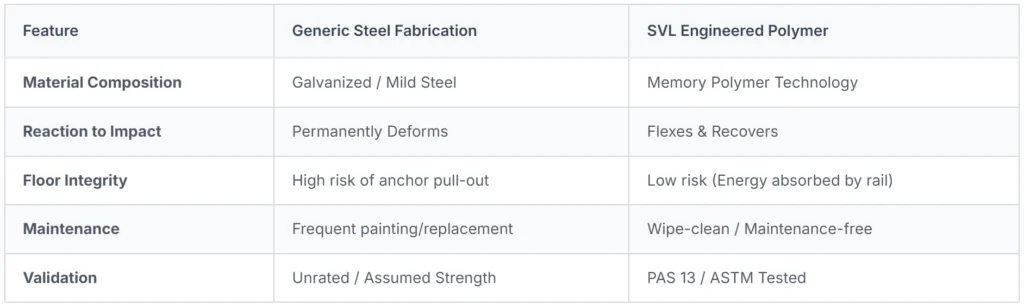
The “Cheap” Trap: Buying based on price-per-meter is a false economy. We focus on the Total Cost of Ownership, ensuring our clients receive the best long-term value.
7. Strategic Opportunities & Market Gaps
7.1 Key Verticals
- Mission Critical: Data Centers and Pharma require high CapEx standards and zero OpEx disruption.
- Live Environments: Retrofitting steel in active warehouses is hazardous (fumes/dust). Our modular, bolt-down systems allow for clean, rapid installation during night shifts.
- Brand Leaders: Companies that require their logistics hubs to reflect the same quality as their consumer-facing brand.
7.2 The EV Infrastructure Gap
As Electric Vehicle charging networks expand across Ireland, protection is vital. Rusty steel bollards clash with modern EV chargers. Our polymer bollards provide a durable, aesthetic match for this modern infrastructure.
8. Client Scenarios & Use Cases
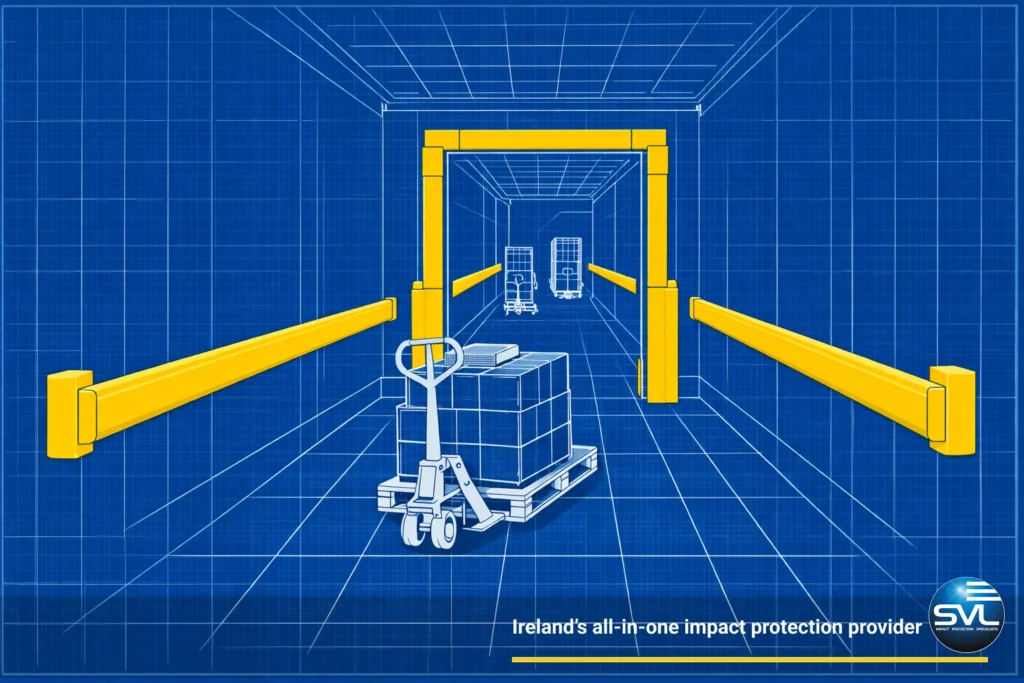
Scenario A: The Data Center Hall
- Issue: A trolley impact scrapes a steel guard, releasing paint chips near a cooling intake.
- SVL Fix: Polymer Corner Guards.
- Result: The trolley deflects off the flexible material. No debris is created, protecting air quality and server hardware.
Scenario B: Retail “Click & Collect”
- Issue: Electric Pallet Trucks (EPTs) repeatedly damage drywall in narrow corridors.
- SVL Fix: HDPE Wall Protection Rails.
- Result: EPTs glance off the rails, leaving walls pristine and eliminating patch-up repair costs.
Scenario C: Pharma Loading Docks
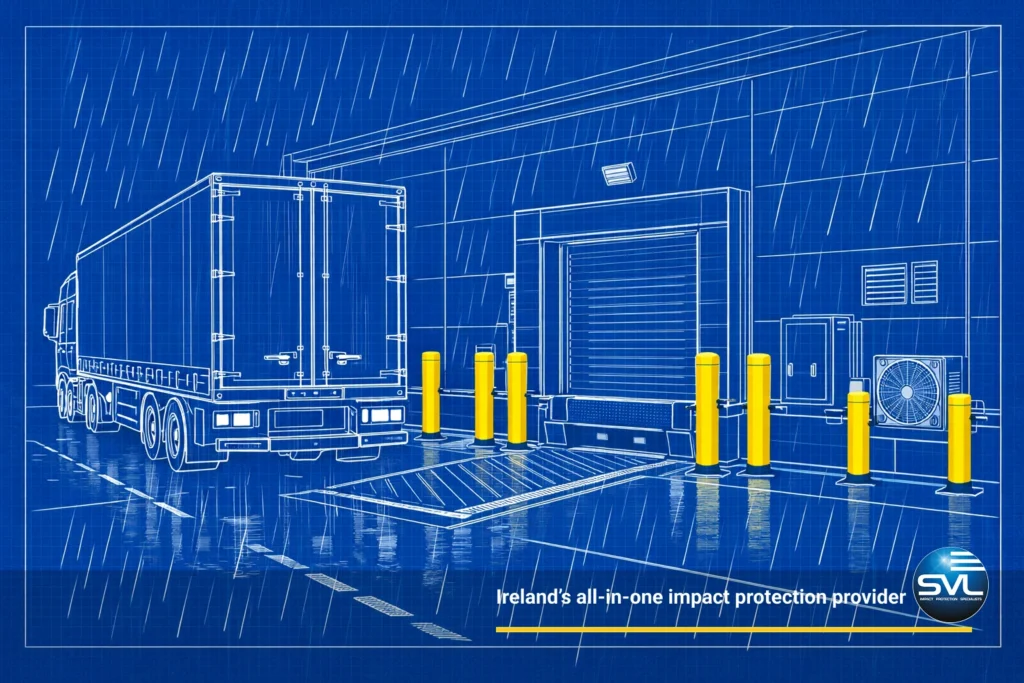
- Issue: Exterior steel bollards rusting due to Irish weather, compromising GMP visual standards.
- SVL Fix: Polymer Bollards with sealed bases.
- Result: Rust-free protection that withstands reversing HGVs.
9. The P.A.C.E. Procurement Framework
We advise clients to evaluate safety partners using our P.A.C.E. methodology:
- P – Physics: Does the supplier have crash-test data for your specific vehicle weights and speeds? SVL provides rated system data.
- A – Aesthetics: Will the product look professional in five years? SVL polymers are UV stable and self-coloured.
- C – Compliance: Does the solution meet HSA requirements for physical segregation? SVL systems provide clear engineering controls.
- E – Economics: Will a single impact require expensive floor repairs? SVL’s shock isolation protects your floor anchors.
10. Future Outlook: Automation & Sustainability
10.1 The Robotic Warehouse
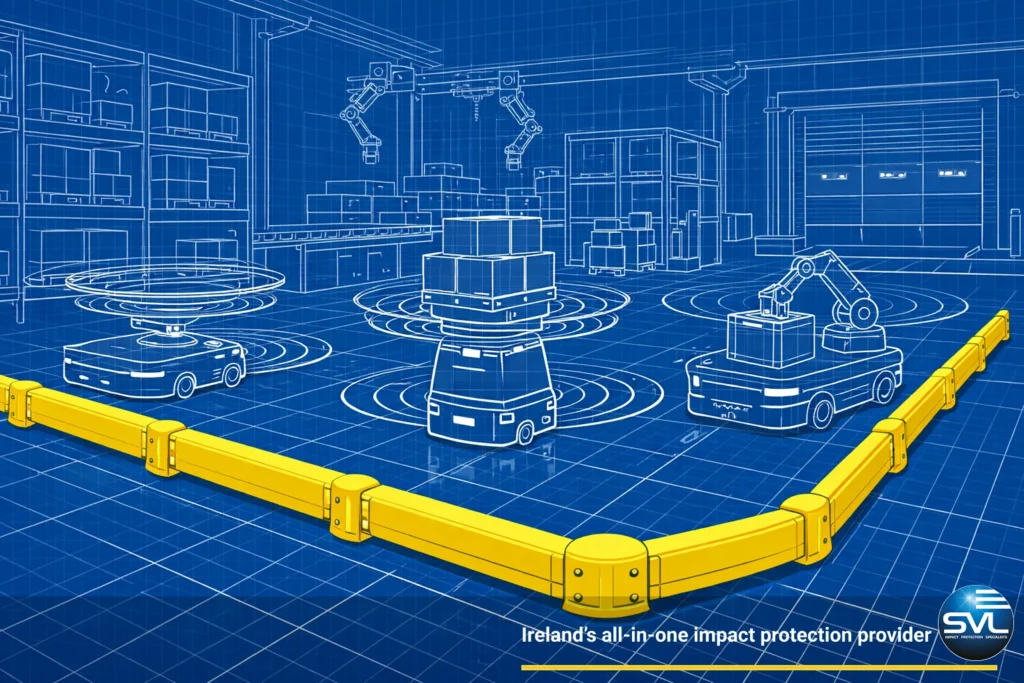
As AGVs and AMRs populate Irish warehouses, barriers must be compatible with LIDAR sensors. We have designed low-profile bases specifically to accommodate these automated systems.
10.2 Green Procurement
Steel production is carbon-intensive. Opting for recyclable polymers that last 20 years (instead of 2) aligns with the sustainability goals of multinational corporations.
10.3 Grid Expansion
With power restrictions easing, existing data centers will look to densify their racks, requiring upgraded internal asset protection.
11. Technical Deep Dive: Anchor Failure Modes
When a 3,500kg forklift hits a rigid barrier at 5.5mph, the energy transfer is immediate.
- Steel Failure: The rigid post acts as a lever, pulling the rear anchors upward. Concrete has low tensile strength, causing it to shear and the barrier to rip out.
- Polymer Success: The barrier material compresses, and the post flexes. This flexibility increases the time duration of the impact. By slowing the deceleration, the Peak Force is drastically reduced, preserving the floor anchors.
12. Sector Focus: Data Centers & Contamination Control
In modern data centers, the threat has shifted from “Zinc Whiskers” to Concrete Dust. Even minor impacts on steel bollards can cause micro-cracking in the floor, releasing silica dust that clogs server filters. SVL provides “Clean Room Compliant” solutions that shed no particles and use shock-absorbing fixings to seal the floor connection.
13. Facility Audit Guide: Identifying Risks
Facility Managers should check their floors for these warning signs:
- Scuff Marks: Black gouges on walls indicate uncontrolled pallet jacks.
- Leaning Bollards: Indicates floor anchors have already failed.
- Unprotected Pedestrian Crossings: A major liability risk under HSA guidelines.
- Damaged Rack Uprights: Twisted metal indicates compromised structural integrity.
14. ROI Analysis: The True Cost of Downtime
Consider a Distribution Center incident where a forklift hits a mezzanine column.
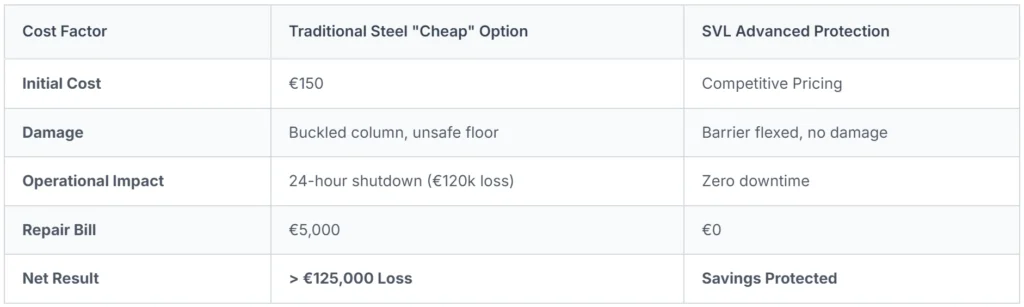
When risk is factored in, the advanced barrier is exponentially cheaper.
15. Cross-Border Compliance (Ireland & UK)
Despite Brexit, safety standards remain harmonized. The UK HSE (HSG76) and Irish HSA both advocate for physical separation of traffic and pedestrians. SVL offers unified specifications for retailers operating across the island of Ireland, simplifying Group Risk Management for chains with locations in both Dublin and Belfast.
16. Conclusion: Future-Proofing Irish Infrastructure
Our name, “Store Vision,” is rooted in foresight. We believe the future of Irish industry is defined by high-value, high-speed operations – whether in robotic warehouses or hyperscale data centers.
In this environment, downtime is unacceptable. Infrastructure must be resilient. SVL provides the hardware that makes this resilience possible, partnering with clients who look at a 10-year horizon rather than a monthly spreadsheet.
References
- Energy Connects: Ireland ends moratorium on new power links to data centers. https://www.energyconnects.com/news/utilities/2025/december/ireland-ends-moratorium-on-new-power-links-to-data-centers/
- Pinsent Masons: Irish data centres power national grid regulator. https://www.pinsentmasons.com/out-law/news/irish-data-centres-power-national-grid-regulator
- Health and Safety Authority (HSA): Workplace Transport Safety Management. https://www.hsa.ie/eng/vehicles_at_work/workplace_transport_safety_management/
- SVL LinkedIn. https://www.linkedin.com/company/store-vision-ltd